How to be Happy
Fourth Sunday of the Year. Fr Robert Verrill explains the relationship between the Beatitudes and the life of virtue.
A few years ago, the University of Chicago undertook a survey on job satisfaction and general happiness. Regarding job satisfaction, in third place were firefighters, in second place were physical therapists, and in first place were members of the clergy. Regarding general happiness, the same survey ranked transportation and ticket reservation agents in third place, firefighters in second, and in first place, again it was the clergy who came out as the happiest.
Now this result of the clergy coming out top in the general happiness stakes may seem rather surprising to many people, but it is probably not quite as surprising as what Jesus says about being happy at the beginning of His Sermon on the Mount in today’s Gospel. What is translated as the word ‘blessed’ is a Greek word that could also be translated as happy or fortunate. The corresponding Latin word, is beatus, from where we get the word ‘beatitude’. So what Jesus says about being poor in spirit, about mourning, and being persecuted is really about how He understands happiness.
Now these sayings about happiness seem so surprising, we might wonder whether Jesus is speaking of something entirely different from what people normally think happiness to be. We might therefore be tempted to say that what Jesus was speaking about was something called ‘beatitude’ to distinguish it from what people normally mean by the word happiness. However, there are reasons to think such a distinction is misplaced, and that beatitude and happiness really do mean the same thing.
In one commentary on the University of Chicago survey on job satisfaction and happiness, it was suggested that people tend to be happy if they have jobs where they can make decisions and build something up based on these decisions. In contrast, the unhappiest people are those who have someone over them, controlling what they do, making unreasonable demands that can’t be satisfied. So both happy and unhappy people are engaged in activity, but for happy people, the source of this activity is from within, whereas for unhappy people, the source of their activity is from without.
Now this understanding of happiness is not so very different from what St Thomas Aquinas says about the beatitudes. St Thomas compares the beatitudes to the infused virtues and the gifts of the Holy Spirit. The theological infused virtues are faith, hope, and charity, and they are dispositions infused in us by God so that we can engage in activities ordered towards our eternal redemption. The gifts of the Holy Spirit build on the infused virtues and make a person more responsive to the promptings of the Holy Spirit. The beatitudes, on the other hand, are the acts that flow from these interior promptings of the Holy Spirit and the infused virtues. Each of the beatitudes involves an activity that wells up from within a person’s being where the Holy Spirit has made His home.
So those who are poor in spirit have actively turned away from prizing worldly goods, since they have set their hearts on the kingdom of heaven. Those who mourn let go of their worldly aspirations, and instead long for the conversion of sinners. Those who are meek are in complete control of their emotions, so that they can wait with tranquil hearts for the promises of Christ. Those who hunger and thirst for righteousness actively pursue works of justice which bring such delight to God. Those who are merciful are full of generosity, actively sharing the mercy they have received from God. Those who are pure in heart have a single-minded devotion to the will of God in all that they do. Those who are peacemakers build up harmonious communities whose members recognize each other’s dignity as children of God. And those who are persecuted for righteousness’ sake actively pick up their cross and follow Christ, confident that He is leading them to the kingdom of heaven.
Modern notions of happiness diverge from the true happiness of Jesus Christ when people seek complete autonomy in their actions and independence from God. The mistake is to view God’s activity and our activity as being in competition. But in reality, there is no competition, for God is the very source of our being – He is closer to us than we are to ourselves. So if we allow God to move us from within, we will be truly happy, we will be truly blessed, for dwelling with God is the activity for which we were made.
Readings: Zephaniah 2:3,3:12-13 | 1 Corinthians 1:26-31 | Matthew 5:1-12a
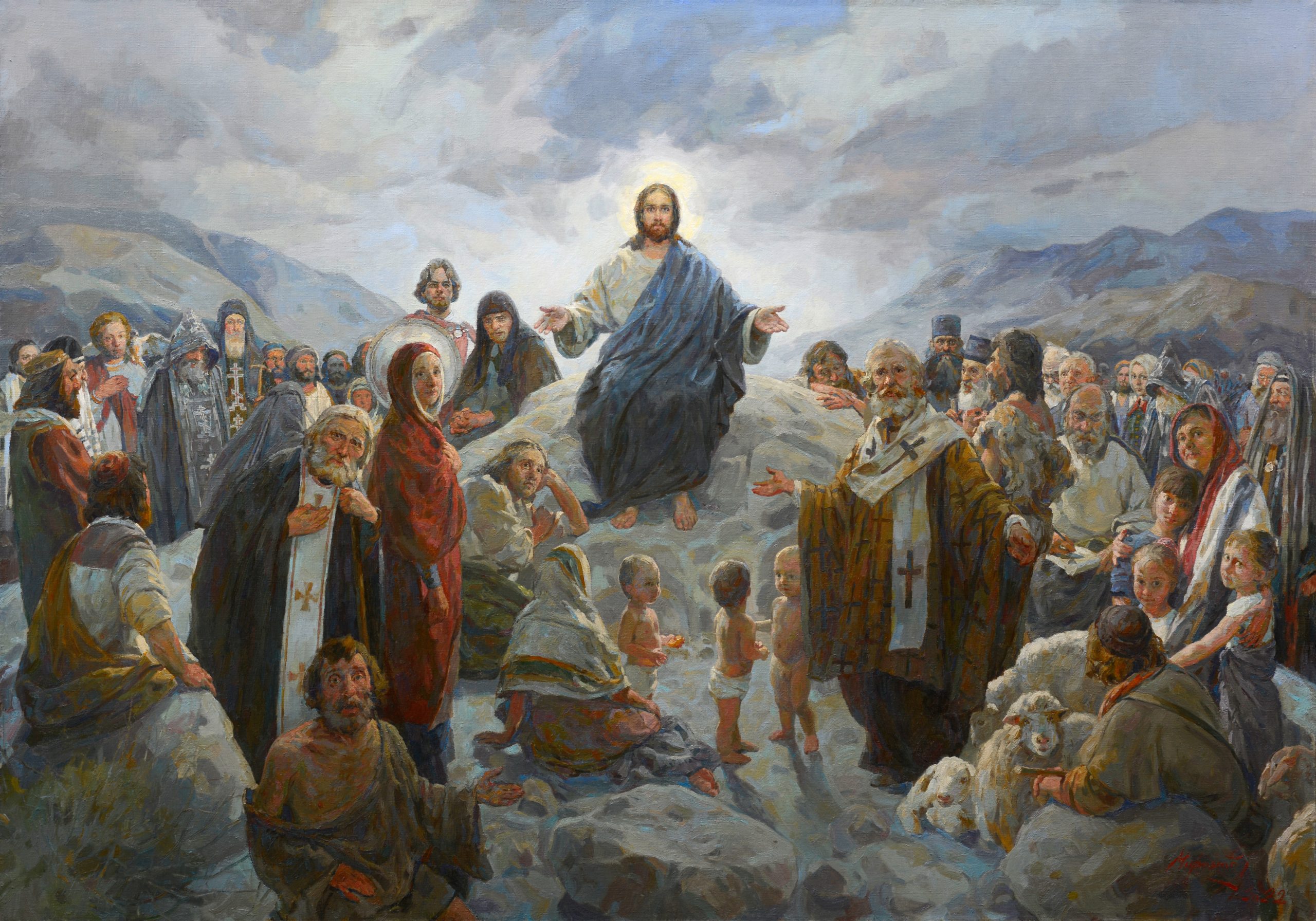
Image: detail from Нагорная проповедь by Andrei Mironov via Wikimedia Commons (CC BY-SA 4.0)