


Notable English Dominicans
The Province of England has produced a number of Dominicans who have been influential in different ways. They are a part of our living heritage and their memory lives on and continues to inform and inspire today’s brothers.
Click to expand each brief biography. Author: Fr Aidan Nichols OP, 2025.
Vincent McNabb (1868-1943)
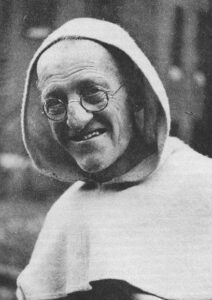
Vincent McNabb was born at Portaferry in Co. Down, the son of a captain in the merchant navy. Although he went to school at St Malachy’s College, Belfast (as a boarder once his family had moved to Northumberland), he identified with the imperial polity then ruled by Britain, or as he was accustomed to say, ‘England’. No doubt that facilitated his entry into the English, rather than Irish, Province. But in any case his attraction to the Order came initially from observation of its pastoral care for the poor at St Dominic’s Priory, Newcastle.
At the Woodchester novitiate he imbibed an ethos of ultra-simplicity of life combined with the punctilious conventual observance represented by the ‘Jandelian’ wing of the mid-nineteenth century Dominican revival. Studying at Louvain, where the English Dominicans had run a college during the Recusant period, he became an admirer of the Belgians – devout (when not anti-clerical), agrarian-oriented and faithful custodians of their artistic heritage.
At home, a ‘career’ in the Dominican houses of study combined with the giving elsewhere of ‘conferences’ on theology and spirituality (notably to Catholic undergraduates at Oxford) was interrupted by a priorship at Holy Cross, Leicester (1908-1914), where he was instrumental in founding the Congregation of Sisters known as ‘Corpus Christi Carmelites’, still active in the English-speaking Caribbean.
During the First World War his robust pleas for help to invaded Belgium and its refugees earned him a chivalric decoration from Albert I in 1919. The giving of Retreat conferences would occupy much of his time in the Inter-War years, together with his well-known appearances at Hyde Park’s ‘Speakers’ Corner’. Along with his asceticism they shaped a reputation for holiness, not always shared by those who had noted the flamboyance of his personal style. ‘Flamboyant’ is hardly a word to describe Leonine Thomism, yet in his intellectual outlook McNabb’s Thomism ran very much along the lines of the (chiefly philosophical) presentation of Thomas desired by Pope Leo XIII. But unlike many Thomists he made the connexion with the other main concern of that pope, the ‘Social Question’, espousing both Distributism (here he joined forces with Hilaire Belloc and G. K. Chesterton) and Agrarianism (‘Back to the Land’), seen as suitable antidotes to the ills of industrial capitalism. His writing on these topics retains an audience among those seeking a non-Socialistic ‘third way’.
Less well known were his ecumenical efforts, which took the form of an especially nuanced version of Catholic apologetics when dealing with Anglo-Catholics combined with an enthusiastic response to the 1920 Lambeth Conference’s call for Christian Unity ‘all round’. McNabb thought the successors to the Tractarians were in process of utterly transforming Anglicanism so that, at any rate, Anglican/Roman Catholic unity was a feasible prospect. His ecumenical sympathies also extended to Nonconformists inasmuch as he praised their appeal to conscience in the conduct of public affairs: after all, he emulated it himself in frequent letters to the national Press.
McNabb was a careful reader of Scripture (he had good Hebrew as well as Greek) and brought to bear on principles of exegesis the logic he had also taught, along with Scripture, at Woodchester and Hawkesyard. Surprisingly, granted the austerity he urged on his brethren, his liturgical instincts drew him toward extravagance, not simplicity. A mediaeval liturgy, largely preserved in amber (the ‘Dominican Use’), could be pressed in either direction.
McNabb was never predictable which was perhaps a factor in the abandonment of the cause for his beatification.
Bede Jarrett (1881-1934)
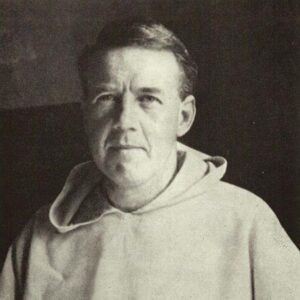
Bede Jarrett was born at Greenwich, son of a colonel of the British Indian Army and educated by Jesuits until his arrival at Woodchester at the age of seventeen to begin both the novitiate and, after profession, the study of philosophy. After theological studies at Hawkesyard, but (shortly) before his priesting, he began a degree in the Honours School of Modern History at Oxford, living with Benedictine monks at Hunter-Blair’s Hall, the forerunner of the later ‘St Benet’s’. It was the seed which, developing, would open as a flower with his re-founding of the mediaeval Oxford Blackfriars when Provincial.
The qualification Jarrett gained in history did not exempt him from further theological studies at Louvain from where he returned to work, more prosaically, in the parish attached to the Priory of our Lady of the Rosary and St Dominic, Haverstock Hill. In 1912 he became editor of the Province’s rather humble journal, the Rosary Magazine which spread information about Dominican saints and devotions, but whose contribution otherwise consisted in inspiring lay-brother vocations in Ireland. At any rate it was good preparation for Jarrett’s eventual founding of the vastly more ambitious Blackfriars (now ‘New Blackfriars’).
In 1914 he was chosen as prior of his own house, a preamble to his 1916 election as Provincial – a post he would occupy for four consecutive terms until 1932, thus making him the principal formative figure on the pre-Conciliar English Province. In addition to the founding of Blackfriars Oxford and a house, serving as University chaplaincy, in the Scottish capital, he initiated the South African mission which would span the cultures of that country by a combination of largely black parishes in the Transvaal and a presence at the ‘Afrikaaner Oxford’, Stellenbosch in Cape Province. There were other imaginative projects, notably in Persia and India, which circumstance aborted. His choice of Shiraz, the mediaeval capital, rather than Teheran, for a Persian foundation was instructive: not that Jarrett was a Romantic transfixed by history, but that he wanted to engage another civilisation at its spiritual heart. A pity that the word ‘inculturation’ had not yet been coined.
At home he transferred the ‘apostolic school’ to a new site at Laxton Hall, Northamptonshire, envisaging there a public school of modest proportions but with a Thomistic philosophy of education to give it a cachet of its own. The demands of administration together with tireless preaching, writing, and perseverance with a voluminous personal correspondence that combines charm and spirituality, help to explain his early death while in post as prior of Oxford in 1934.
Jarrett was a gifted historian, not least of the English Dominican Province, even if his multiple commitments disabled him from persistence in British Museum scholarship. His essentially practical moral intelligence attracted him above all to issues of political economy and social theory, as in his Social Theories of the Middle Ages and Mediaeval Socialism, or his study of Antoninus of Florence and ‘mediaeval economics’. Evidently, he hoped to find guidance for contemporary social re-organisation in mediaeval precedents, an aspiration which linked him to the Guild Socialists of his day and even to some in the nominally Marxian Social Democratic Federation. Though Jarrett’s commitment to the parochial work inherited from the Victorian Catholic revival did not please all proponents of a fuller conventual observance, and his insistence that the Province should enter intellectually into the mainstream of British culture offended those who wished instead to mount a counter-cultural offensive, he remains by and large in the corporate memory the ideal English Dominican, and more especially the ideal English Dominican superior.
Aelred Whitacre (1882-1945)
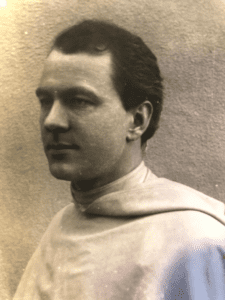
Aelred Whitacre was born at Birmingham to a family of jewellers with other crafts connections by way of marriage. After education at St Philip’s School, Edgbaston, he attended the Dominican ‘school for postulants’, moving as it did in his time from Hinckley to Hawkesyard. Noviciate and philosophy at Woodchester brought a lifelong friendship with Bede Jarrett. Expressed in letters and poetry, it was of the kind disliked by monastic rigorists as ‘particular’.
Whitacre’s theological studies took place entirely at Louvain (1902-1907), whence he returned a convinced Thomist to teach, in the first place, philosophy for the Dominican students at Hawkesyard. When disappointed in his wish to teach theology instead, and to do so, failing an opening at home, to Benedictine juniors in Bavaria, he sought to introduce the Summa theologiae to a wider British public at Caxton Hall, the well-known Central London venue for meetings (1916-1918). Whitacre’s enthusiasm for the popular diffusion of Thomism led him to translate from French a classic of ‘Thomism of the Strict Observance’, by Thomas Pègues, a professor at Rome’s Collegio Angelico from the years 1909 to 1921 and subsequently, at Saint-Maximin in Provence, an inveterate opponent of all attempts creatively to ‘spin’ the Neo-Thomist St Thomas. A 1993 reprinting of Whitacre’s 1922 translation shows there remains a demand for such austerely propositional doctrinal overviews.
 In the 1920s, Whitacre was a Woodchester-based giver of Retreats and parish Missions and in the 1930s a University chaplain at Edinburgh, though ill-health and a degree of lassitude were taking their toll. A fine musician, he was also an accomplished sculptor, who received commissions from various Roman Catholic institutions, leaving the Province with Whitacre artworks at Oxford (Stations of the Cross and a ‘Throne of Grace’ in the tribune of the church), Stellenbosch (Stations again), Cambridge (St Michael and the Dragon over the original entrance together with a Crucifix in the original oratory), Edinburgh (Albert the Great over the entrance), Woodchester (an Annunciation, over the church door). While he had attended classes at the Slade School of Fine Art, he preferred to remain for the most part an auto-didact, so as to preserve his originality of style, which in these friezes is spare and iconographic.
Though Whitacre contributed philosophical articles to the Catholic Encyclopedic Dictionary and more substantial essays on Thomism and on one of its Counter-Reformation competitors, Molinism, to the prestigious ‘Hastings’ Encyclopaedia of Religion and Ethics, as well as articles to Jarrett’s ‘Blackfriars’, his principal legacy to the Province is as a visual artist who might in other circumstances have been allowed a studio to continue a unique work.
Victor White (1902-1960)
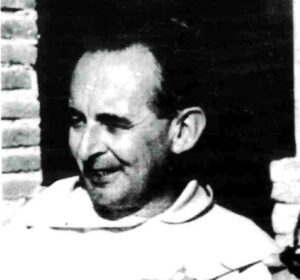
Victor White was born in Croydon, Surrey, the son of an Anglican clergyman. Received into the Catholic Church as a young man, he tried his vocation for a while with the secular clergy at the English College in Valladolid before entering the English Dominicans instead. Proceeding seamlessly through Woodchester, Hawkesyard, and Louvain to the newly opened Blackfriars Oxford, he became a lector there in dogmatic and moral theology in 1929 and remained in post, immensely fruitfully, till 1954.
White’s writings proved him to be a winning spokesman for Christian Scholasticism as found in Aquinas, its most celebrated representative. He stressed its patristic resources which, by way of both ‘affective knowledge’ and its seeming opposite, apophaticism, laid it fully open to the mystical dimension, but also the new rigour such Scholasticism brought to its philosophical component. Simplified for more popular consumption in the writings of his younger contemporary Gerald Vann, that combination of qualities might even be said to constitute a specifically English Dominican ‘reception’ of Thomas.
White’s studies of Christian doctrine brought together in God the Unknown ranged exceedingly widely, taking as interlocutors Karl Barth and the sages of India, yet always remaining faithfully anchored in Catholic and evangelical soil. His ecumenical passions, usefully invested in sub rosa talks between Dominicans and Anglo-Catholics of the Society of the Sacred Mission, were chiefly stirred by Eastern Orthodoxy, to the point that he contemplated joining a proposed bi-ritual (Latin/Byzantine) Benedictine house in England, on the model of the ‘monastery of union’ created by Lambert Beauduin in Belgium.
Personal anxieties, generated in part by this projected change of life, led him, fatefully, to Jungian analysis and ultimately, in 1945, to relations with Jung himself as the Swiss depth-psychologist’s much favoured ‘white raven’. He was indeed suited temperamentally and by keenness of mind to be the theological collaborator Jung has long desired. But the publication in 1954 of the English translation of Jung’s Answer to Job, in describing the ‘shadow-side’ of the ‘God-archetype’ damned him by association, and lost him the post of ‘Regent of Studies’, token of the intellectual leadership of the Province. His return from a thinly disguised exile in California coincided with the onset of serious illness, compounded by a motor-cycle accident from which he never fully recovered. His philosophically acute contributions to discussion of the relation of ‘soul and psyche’ remain, however, of lively interest to both psychologists and theologians in a later period.
Thomas Gilby (1902-1975)
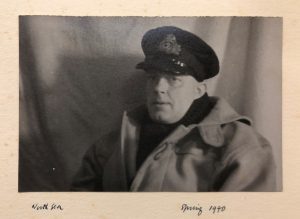
Thomas Gilby was born in Birmingham to a family newly converted to the Catholic Church. From St Philip’s School he moved, at the age of only sixteen, to the Woodchester novitiate, and via Ordination studies at Hawkesyard to Louvain where he gained a doctorate in sacred theology and the profound immersion in Thomas and Thomas’s principal historic commentators which lay at his fingertips for the rest of his life.
Back in England, his teaching of moral theology at Oxford, combined with responsibilities in the editing of Blackfriars, exposed him to controversy over the legitimacy of ‘natural family planning’ which, despite Pope Pius XI’s encyclical on marriage, left some pastors jittery. Moving to London, to teach at the Society of the Holy Child Jesus teachers’ training college and act as a regular contributor to the London University Extension Lectures, his intellectual brio gave him easy access to the Catholic literary intelligentsia of the capital. The Second World War further extended his experience to the Royal Navy, of which he wrote a history.
Thoroughly identified with the Cambridge priory – named originally ‘Blackfriars St Michael’s’, he effortlessly embodied its intended ethos as a ‘house of writers’, putting out books on traditional logic, epistemology and metaphysics, as well as political theory, which are the nearest thing to charming as Aristotelian Thomism is ever going to be – even if more radical voices in the Province found his commendation of that tradition’s political ethics insufferably Whiggish. He had perfected a stylistic fluency already apparent in his most innovative work, an inter-War study of ‘poetic experience’.
Two substantial anthologies, one philosophical, the other theological, of gracious translations of selected extracts from Aquinas’ corpus, prepared him to become editor of a sixty-volume bilingual edition of the Summa theologiae, with copious introductions, appendices, and notes, a collaborative work which occupied him for the rest of his life. With the dip in Aquinas’ reputation which followed the Second Vatican Council, bringing the series to a successful conclusion was enabled by the generosity of Gilby’s publisher, Oliver Crosthwaite-Eyre, on whose yacht he recuperated from his exertions during voyages to the Eastern Mediterranean.
Gilby’s novels, like his study of ‘Morals and Marriage’, were pseudonymously written but are necessary reading for an overall grasp of his well-stocked mind. The David Roberts building which joins together the two early twentieth century villas that make up the modern priory at Cambridge remains the only realised portion of Gilby’s ambitious architectural project for an international Dominican study-house in the Fens.
Conrad Pepler (1908-1993)
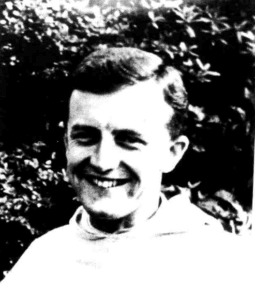
Conrad Pepler was born in Hammersmith to a Quaker family who, through his father, Hilary, later to be famed in the annals of Lay Dominicans, became Catholics in 1917. Hilary Pepler’s creation of a bespoke community of artists and craftsmen on Ditchling Common in Sussex, following the rule and ‘Little Office’ of Dominican Tertiaries, formed the background of his son’s early life – along with the ‘apostolic school’ at Hawkesyard to which he was sent at the age of 11.
After priestly Ordination he wrote a thesis for Rome’s Collegio Angelico on the manner of Christ’s exercise of his high priesthood in the Eucharistic Liturgy, the first of several studies in which he sought to present the liturgical life as formative for Christian existence more widely. Had it not been for the opening of hostilities in Europe in 1939 he would have continued that theme at the short-lived ‘school for novice-masters’ established at the seat of the Master of the Order, Santa Sabina.
As it was he remained in England but not, however, at Hawkesyard where, rather against the grain, he was teaching the history of philosophy – if also cosmology, a subject which, had an Aristotle-centred syllabus permitted, he could have enlivened by his proto-ecological feeling for the rhythms of nature. Instead he went to Oxford where as cantor and student master he had plenty of energy left over to be editor of Blackfriars, founder of a companion journal for spirituality, The Life of the Spirit (later to be merged with its elder brother as ‘New Blackfriars’), and, inspired by the example of the Province of France, though on a far smaller scale, of a publishing house: ‘Blackfriars Publications’, a work for which his father’s espousal of fine printing prepared him.
In 1953 he became Warden of ‘Spode House’; the celebrated porcelain manufacturers’ family home, subsequently surrounded by the grounds of Hawkesyard, had taken on a new life in Retreat and Conference work. His circle of admiring contacts widened enormously, and by dint of early rising he was able to keep up his writings among which the 1958 study The English Religious Heritage merits special mention. It played a major role in stimulating learned study of the mediaeval mystics of England, now a booming scholarly enterprise. In 1981 Pepler retired to Cambridge where his preaching became reduced, like (according to ancient tradition) that of St John, to the simplest of all Christian messaging.
Cornelius Ernst (1924-1977)
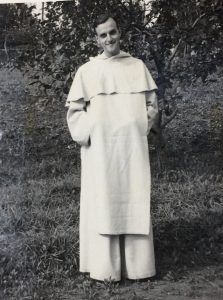
Cornelius Ernst was born to an Anglican family in Ceylon (now Sri Lanka), the descendant of the erstwhile Dutch colonists of the island. He was sent to England for his education, at the City of London’s prestigious – since Renaissance-founded – St Paul’s School. While on a home visit he found himself unable to return through the outbreak of the Second World War. The University of Ceylon made him both a Singhalese nationalist and a Communist, the latter identity distinctly short-lived. When travel conditions permitted he entered Magdalene College, Cambridge, where in private reading he was exposed to the Christian Existentialist philosophers (especially Kierkegaard and Berdyaev), returned to Anglicanism, found the beginnings of a philosophical awakening at Wittgenstein’s last ever lecture course, and through reading Newman’s Apologia pro vita sua decided to become both a Catholic and a Dominican, though knowing little of, at any rate, the latter.
He entered at Woodchester in 1949, moving on to Hawkesyard (whose ‘stripped for action’ austerity he never ceased to defend against critics), and thus to Oxford where he was priested in 1954. Put in charge of philosophy teaching at the Staffordshire priory he sought to renovate a rather formulaic Aristotelianism by looking at matters through the lens of Wittgenstein’s thought. A further breakthrough was more personal: forging an English vocabulary to serve as translation for Karl Rahner’s, Heidegger-indebted, re-presentation of the Scholastic tradition in the collected essays for which Ernst hit on the Wittgensteinian title ‘Theological Investigations’.
Ernst was deeply, if agonisingly, concerned for the renewal of not only Catholic philosophy but also theology, as he had opportunity to show when he moved to Oxford as Regent of Studies in 1966. His many-sided mind (social anthropology and the religions of south Asia were other consuming interests) could not synthesise its own contents in a way that satisfied the most exigent self-imposed intellectual demands – which is why his own output (a small book on grace, a volume in the ‘Gilby’ Summa, and essays on a variety of theological topics of the highest quality) is so meagre and his influence on the post-Conciliar reshaping of the Studium comparatively weak.
In 1975, owing to disagreements about the conventual life (he regretted a laxity which sometimes came close to anarchy but had no confidence in any merely authoritarian reimposition of control), Ernst left Oxford for the post of chaplain to enclosed Dominican nuns on the Isle of Wight where he died very suddenly at the age of 53. His writings have rightly been described as filled with seeds which, suitably watered, could still fructify to the benefit of Catholic thought – above all, in regard to its metaphysical foundations.
Herbert McCabe (1926-2001)
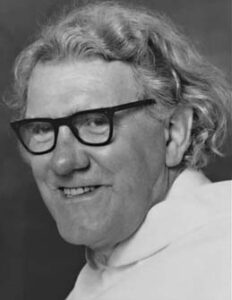
Herbert McCabe was born in Middlesbrough in the North Riding of Yorkshire, the son of a schoolmaster. Enrolled at the University of Manchester to read Chemistry he quickly changed to Philosophy where he came under the influence of Dorothy Emmett, a rare example in the period of an English philosopher who combined the acute Socrates-like enquiry into word-use as favoured by linguistic philosophy with a highly positive attitude to metaphysics.
He joined the English Dominicans in 1949 and, on Ordination, served his turn as curate in the parish of St Dominic’s Priory, Newcastle, before being commissioned to find a Mancunian base for the Province whose Late Victorian priory buildings and church at St Sebastian’s, Pendleton (in Salford), were lost to irreversible physical deterioration. By then he had completed a tour de force of a lectoral thesis on God and evil in Aquinas, in which he employed Wittgensteinian as well as Thomist strategies of thought in the characteristically pellucid manner which served him well as he began an apostolate to student societies in the Universities of Britain. His addresses form the origin of the only two full-length books he produced in his lifetime, one in ethics/moral theology, the other a study of the sacraments: both were widely enjoyed for their combination of Chestertonian pungency and sharp analysis of themes.
In 1966 he went to Cambridge to begin a spell as editor of the recently renamed New Blackfriars. An editorial seeking to defend the claims of the Catholic Church against a celebrated former priest-theologian, Charles Davis, conceded the manifest presence in Church and Papacy of corruption, in a manner which excited the ire of the apostolic nuncio to Great Britain. (Very) briefly suspended from the exercise of the priesthood, McCabe was reinstated as editor in 1970, now at Oxford, after an outcry which galvanised the ‘progressive’ laity who, in this particular case, were properly concerned with ecclesial justice and not simply, along with other liberals of all stripes, freedom of speech.
Light duties in the Studium (though he was also novice-master from 1981 to 1988) enabled him to resume regular, if occasional, lecturing at the Universities of Bristol and Malta as well as on American campuses. The quality of his material became better known when a late-life collection of essays, God Matters, was followed after his death in Oxford, from complications after a fall, by a flow of further such collections edited by his younger confrere, the philosopher of religion Brian Davies. He is widely credited with the founding of ‘Grammatical Thomism’, the title of which, if controversial, does at least have the virtue of bringing together the Anglo-Saxon and Scholastic threads in his thinking.
Among the topics he addressed, the treatment of the philosophy of mind and approach to ‘virtue ethics’ were outstanding, while the fuller range of his theological wisdom was exhibited in 1985 in his concise ‘Catechism’, The Teaching of the Catholic Church. That little book broke the mould in post-Conciliar catechetics by restoring a properly doctrinal notion of religious education and thus prepared the way for the mammoth 1992 Catechism of the Catholic Church, and its summary question-and-answer follow-up, the 2005 Compendium of the Catechism of the Catholic Church.