Living Up To Our Humanity
Fifth Sunday of Lent. Fr John O’Connor preaches on the weeping, laughing Christ.
The great English writer, John Donne, in a sermon from 1622, asked the following question:
And when God shall come to that last act in the glorifying of man, when he promises, to wipe all tears from his eyes, what shall God have to do with that eye that never wept?
What shall God have to do with that eye that never wept? What shall God do with the eye that never shed a tear?
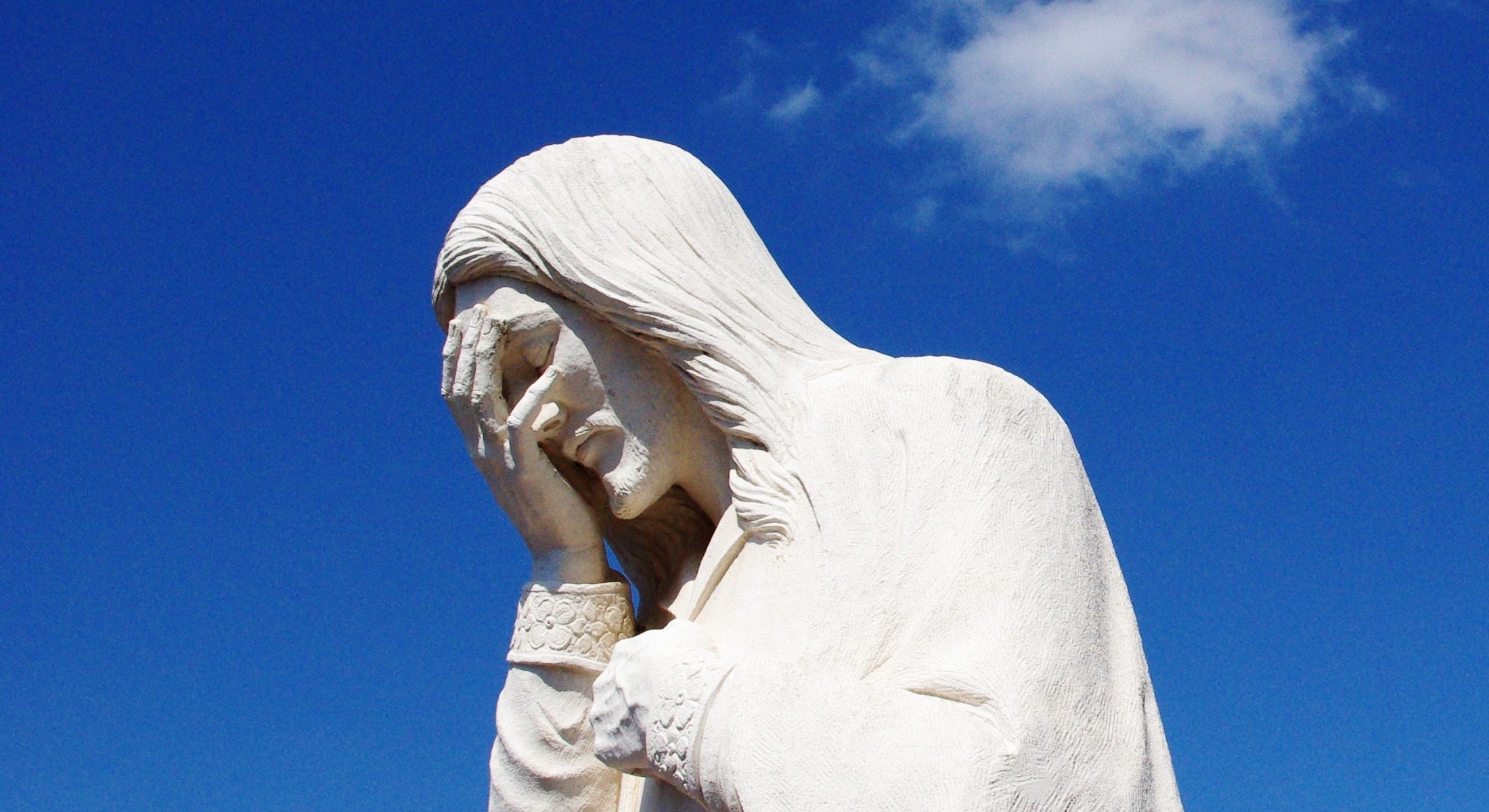
St John in his Gospel tells us, in the shortest verse in the bible, that: ‘Jesus wept’ (John 11:35). What makes this very short verse so important for many people is that here we see Jesus’s humanity, with ordinary human responses like the ones you and I have. The implication of the verse, and Donne’s rhetorical question too, is that it’s right and proper for us to respond to the various things of life in a genuinely human way, which can involve sometimes shedding a tear. It is okay to be human in that way, with all its vulnerabilities. After all, none other than Jesus himself wept. Jesus openly embraced our humanity.
That said, many people have pointed out that even though the Gospels tell us that Jesus wept, they never say: ‘Jesus laughed.’ But laughter is also part of human life.
Mind you, it is worth keeping in mind that Jesus ate and drank with sinners and tax collectors. I would expect the sinners and tax collectors to have had some levity in how they engaged with one another. If Jesus never beamed a warm smile or never laughed, it would have been surprising if the sinners and tax collectors would have responded to him so favourably given that he also challenged them about how they lived their lives.
I also think Jesus used humour in his preaching. He told us that it is easier for a camel to go through the eye of a needle than for a rich person to enter the Kingdom of Heaven. The rhetorical image is reminiscent of the old joke: How can you fit four elephants into a minibus? (Answer: ‘It’s simple! Two in the front and two in the back!’). Jesus too uses an outlandish example of big unwieldy animals trying to squeeze into a small space.
The use of humour in no way undermines that Jesus is also making a serious point. Humour can sometimes be serious, challenging, uncomfortable, and profound. We should also not forget that during this season of Lent we hear at Sunday Mass two passages from St John’s Gospel that contain humour due to misunderstandings of what Jesus and others say: Jesus and the Samaritan woman at the well (Chapter 4) and Jesus and the man born blind (Chapter 9). There is certainly no lack of gravity and profundity in these texts, even if they can also raise a smile.
This Sunday’s Gospel reading, John 11:1-45, is similarly rich. A single sermon can focus on only a small part of its meaning. One element is that the Gospel presents us with a particularly moving instance of the humanity of Christ, who, though divine, shed a tear at the death of a dear friend. Christ openly embraced his humanity in its fullness.
Of course, human nature has its less edifying dimensions. History presents us with, among other things, a catalogue of cruelties perpetrated by human beings – in which humanity is disrespected and defaced both in the perpetrators themselves by their own actions and, in a very different way, in the victims due to what they are subjected to.
But in Christ we are also shown what human nature is, by God’s grace, capable of becoming. Indeed, the example of Christ teaches us that our humanity in its fullness – which includes its vulnerabilities, variations in feelings, and its laughter too – is not something to be despised or to escape from. Our Christian lives are not about transcending our humanity; but, rather, about seeking with the help of God to do justice to its deepest purpose and value.
In Christ we are shown that humanity in its authentic fullness is precisely where the beauty of God can be most deeply manifest. For we are never more truly human in its authentic fullness than when our hearts and minds are touched and elevated by the grace of God. It is sin that makes us less human. Human perfection, humanity in its fullness, is thus not something sterile and aloof, but can weep and laugh.
We are now not far away, my dear brothers and sisters, from the great celebration of the Triduum, the great celebration of the institution of the Eucharist, the Passion and death of Christ, and the Resurrection. In this great drama we go from a man sweating blood in Gethsemane, to the same man dead tortured and on a cross, to the very same man now risen in glory.
Here too we learn some more about human nature, both the depths of the suffering it can experience and the heights to which it can rise in glory, both body and soul together raised up in the eternal resurrected state. All this involves the very same humanity that weeps and laughs, the very same humanity that you and I have, the very same humanity that by God’s transforming and saving gift can become Christ-like.
We should thus never lose sight that Christianity proclaims a very high theology: a very high theology of the vocation and calling of the human being, a very high theology of what we are as human beings. It’s both a challenge and a comfort, though it surely is something to rejoice in.
Let us seek to live up to what our humanity is called by our loving God to be; let us seek to live up to this in our weeping and our laughing, that we may one day experience humanity in all its eternal glory. Amen.
Readings: Ezekiel 37:12-14 | Romans 8:8-11 | John 11:1-45
Image: detail from ‘Jesus Wept’ by Jerry Worster (CC BY-NC 2.0)