Loving Beyond
Trinity Sunday. Fr Bruno Clifon considers the relationship between love and judgement.
Trinity Sunday Torch
There doesn’t seem to be much about the Trinity in the scripture for today. The Gospel, including the most famous verse in the whole Bible, John 3:16, doesn’t mention the Spirit. And Moses’s glimpse of God’s being doesn’t mention Spirit or Son.
What Exodus and John’s Gospel seem to be talking about is judgment.
Our lectionary prudently omits one aspect of Moses’s vision, that the Lord ‘forgives iniquity and transgression and sin, but will by no means clear the guilty, visiting the iniquity of the fathers on the children and the children’s children, to the third and the fourth generation’ (Exod 34:7).
The Gospel in its turn uses the verb ‘condemn’ three times. While God does not send the Son for condemnation, nevertheless, without believing in the Son, condemnation is the consequence. Do we bring it on ourselves? It sounds very harsh.
Salvation seems to rest on believing, believing ‘in the name of the only begotten Son of God’ (John 3:18).
But how do we do this and what does this have to do with the mystery of the Trinity, God’s life? Why this risk of condemnation?
There is an important priority behind John’s words.
The mystery of God’s life appears in the world through God’s actions in saving it. In other words, it is by being saved that we learn who God is, not the other way around.
The clearest visibility of the Son being sent into the world ‘in order that the world might be saved’ (John 3:17) is Jesus’s death and resurrection. And, when about to fully reveal his sending, Jesus at the Last Supper promises to send into the world another friend like him, the Spirit. We celebrated this sending last week at Pentecost.
Now, what believers experience as two sendings is really the one God showing us who he is all at once: ACTIVE LOVE—lover, loved and love itself.
But then, why let us in on such a divine mystery?
While active love’s loving is perfect in its love, we learn from the Trinity’s saving activity that love wishes to love beyond itself.
God wants to share the love. He wants to bring us into his life, to be among the loved, loved by the lover with love itself.
Thinking then about our gospel, how can this loving picture possibly be associated with judgement?
We need to remember that the Gospels were written after Easter and Pentecost, in their light. They are not live coverage, monitoring events as they unfold. The Good News was already being preached, and many were already believers, on fire with the Spirit and disciples of Jesus the Son, when they read John’s words. Deep down, they already knew who God was through being saved.
And this is why for John ‘whoever does not believe is condemned already.’ For if we’ve learnt who God is because he has saved us, and yet do not accept this truth, doesn’t this mean that we evade the salvation that belief animates? John seems to have personal experience of such a sad dilemma that shows in his letters.
‘They went out from us, but they were not of us; for if they had been of us, they would have continued with us. But they went out, that it might become plain that they all are not of us’ (1 John 2:19).
We can’t think that we are free of such indecision and doubt. We who have come to know the Trinity’s love continue to reject this opportunity through sin. We read these texts so as not to disguise the inadequacy of our judgment presented with God’s love.
Yet the Trinity’s infinite love is such that it constantly reaches out to reset our invitation into love itself. The effect of such love is seen when we are like God and love outside of ourselves.
‘Beloved, let us love one another, for love is from God, and whoever loves has been born of God and knows God. Anyone who does not love does not know God, because God is love. In this the love of God was made manifest among us, that God sent his only Son into the world, so that we might live through him’ (1 John 4:7–9).
Readings: Exodus 34:4-6,8-9 | 2 Corinthians 13:11-13 | John 3:16-18
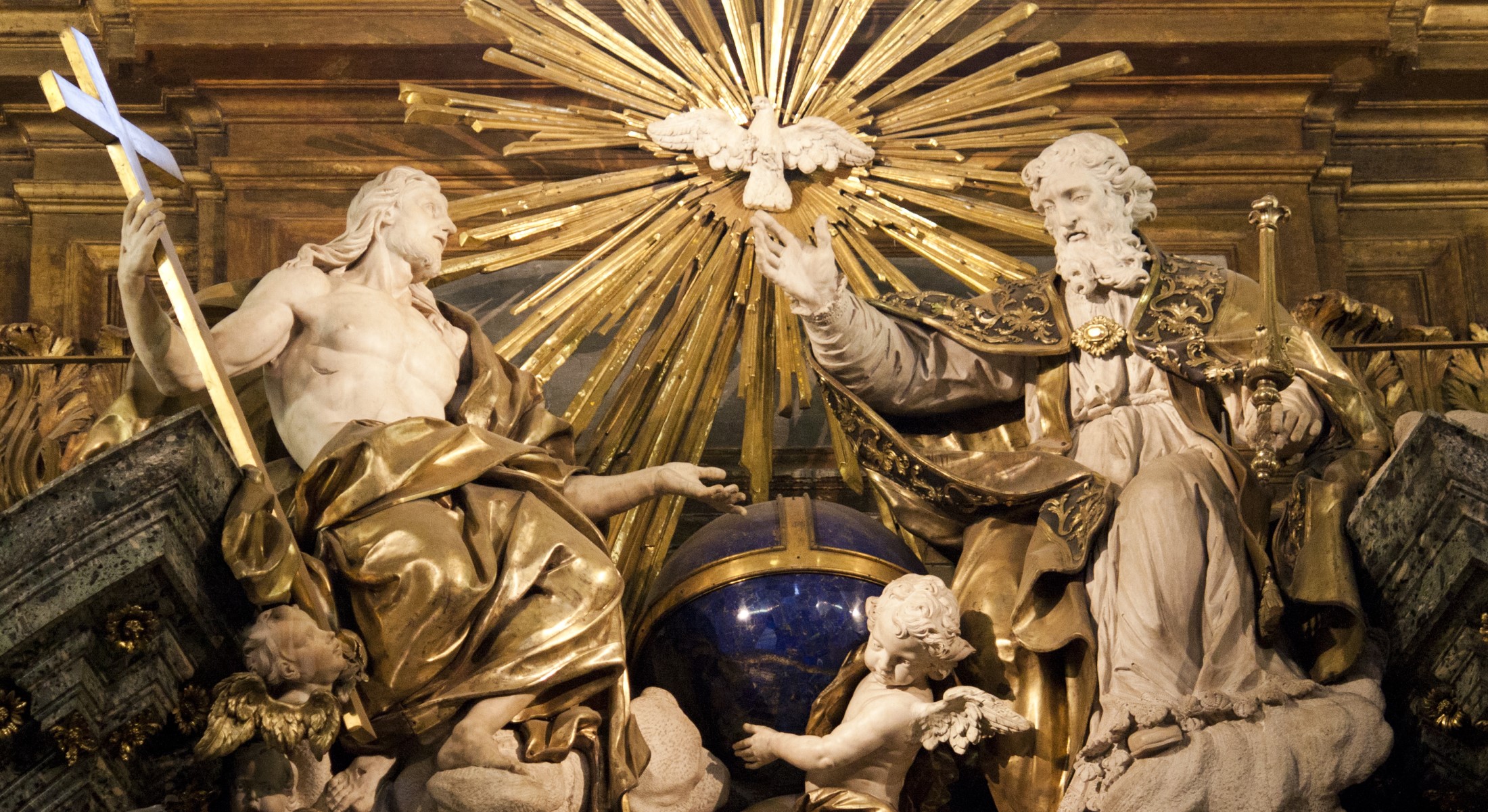
Image: detail from the altar of St Ignatius Loyola by Andrea Pozzo in the church of Il Gesù in Rome, photographed by Fr Lawrence Lew OP