

Coming and Going
Fourteenth Sunday of the Year. Fr Matthew Jarvis is inspired by a detail on a crucifix.
In my room I have a cherished icon. It shows Christ in a posture of blessing, with an open book in his hand. In the book are inscribed in Greek the words of today’s Gospel: Come to me, all you who labour and are overburdened, and I will give you rest. For me, this icon is a defining image of Christ: the one who blesses, who speaks gracious words, who reveals the Father’s love to us. No one knows the Father except the Son and those to whom the Son chooses to reveal him. And the Son has indeed chosen to reveal the Father to us, by revealing himself: He who has seen me has seen the Father(Jn 14:9). I can think of Christ blessing me personally when I look at this icon, but I know too that he is blessing each one of us. These are words of blessing for the whole world.
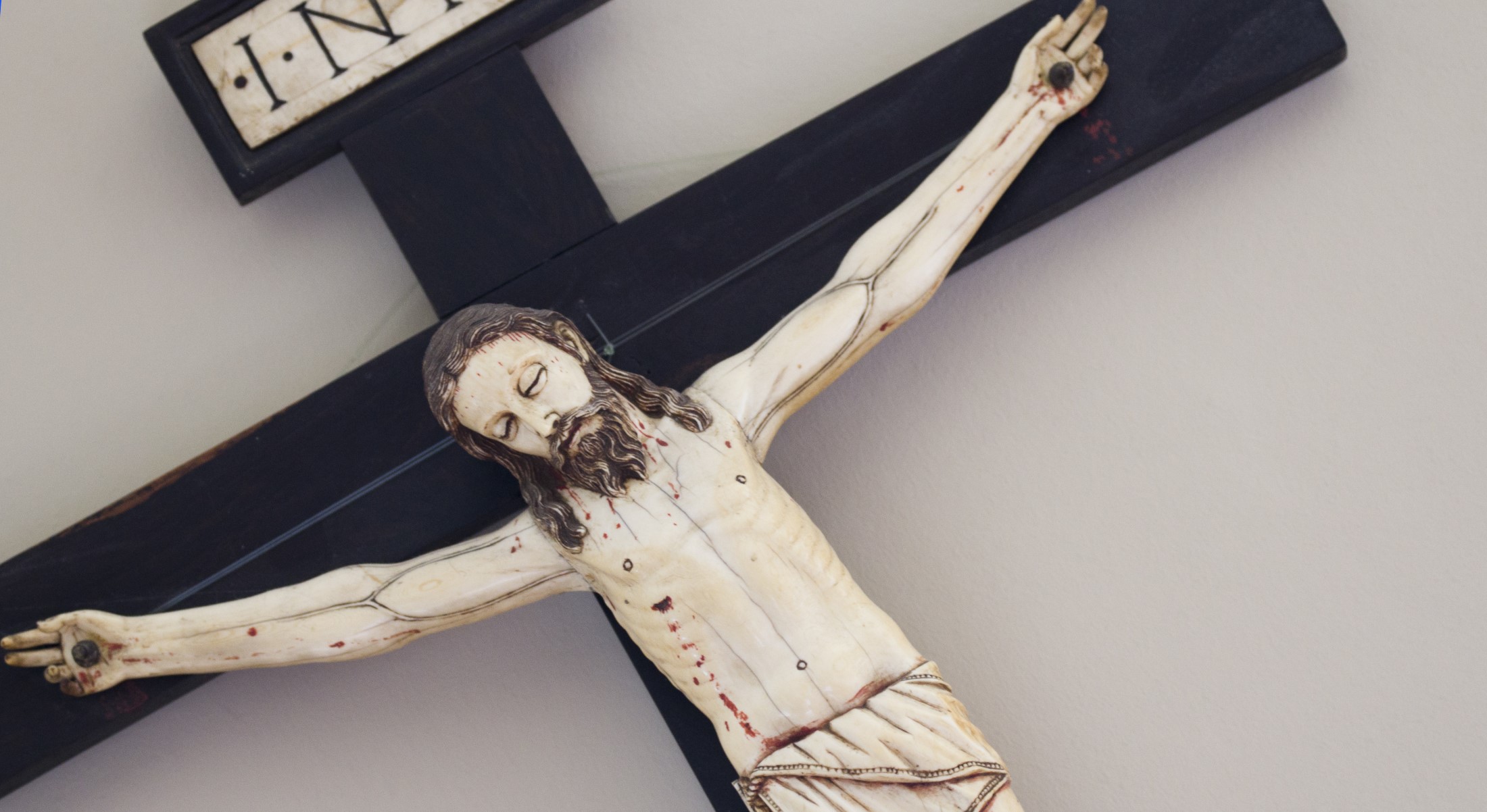
Where I live at St Dominic’s Priory in north London, we have a great church called the Rosary Shrine, which has an extraordinary array of side chapels for each of the mysteries of the Rosary. In the chapel of the Fifth Sorrowful Mystery – the Crucifixion – the sculptural arrangement is very traditional: Christ on the cross, his mother Mary and beloved disciple John standing on either side, and the penitent Magdalene embracing his nailed feet. But I recently noticed an important but easily overlooked detail: Christ’s right hand, although nailed to the Cross, is in the blessing shape, like in my icon. So God in Christ is blessing us, and yet our response is to reject his blessing, to nail his blessing hand to the Cross. And yet Christ continues to bless us even from the Cross. No nails, no human wickedness, can possibly prevent Christ blessing us. The question is – and this Rosary Shrine chapel eloquently confronts us with it – do I want to receive this blessing? It might cost me my pride, accepting my own weakness and shame, as I grow in humility and turn to the one who is trulygentle and humble in heart.
If Christ reveals an unconditional love of blessing to us, this must come ultimately from God the Father whom Christ came to reveal. Indeed he says that this pleased his Father. A more expressive translation says: Yes, Father, for such was your gracious will. This gracious will of the Father (eudokia in Greek) is sung by the host of angels at Bethlehem: Glory to God in the highest, and on earth peace to people of [God’s] good will (eudokia again). We can specify that this is God’s good will, because some early versions of Luke 2:14 put it this way: Glory to God in the highest, peace to the earth, good will to humanity. As with Christ blessing all of us, so the Father’s gracious will is revealed at Bethlehem as a gift to all humanity. That gift, of course, is the presence of Jesus among us. How do we respond to this great gift, this gracious will?
Fulton Sheen has a wonderful reflection on two very simple imperatives that Christ uses throughout the Gospels – Come, come, go, go! Our Lord says, Come, follow me… Come and see… Come and have breakfast… Go and do likewise…. Go and sin no more… Go in peace… and many more. In today’s Gospel, we hear the beautiful invitation: Come to me, all you who labour and are overburdened, and I will give you rest. The simplicity of Come and Go shows that Jesus is truly addressing all humanity; no one can claim this is too complicated to understand! Even mere children can grasp what Jesus says here, often better than the more learned and clever. This echoes the innocence of Adam and Eve in the Garden of Eden, who before their Fall are described by St Irenaeus and St Theophilus as mere children or infants (the same word nēpios in Greek). This may refer to a spiritual and psychological immaturity, not necessarily a physical infancy. In any case, God gave Adam and Eve instructions which they could perfectly grasp as he imparted his original blessings to them.
Now, in our fallen state, Christ still tells us to come, but adds two more imperatives: Shoulder my yoke and learn from me. Life is difficult and demanding as a result of our sins and those of others. But thank God that his yoke is easy and his burden light. No matter what our struggles, whatever cross we have to bear, we can know that God’s gracious will is leading us back to him, if we keep our eyes fixed on his Cross, from which he continues to bless us.
Readings: Zechariah 9:9-10 | Romans 8:9,11-13 | Matthew 11:25-30


Catherine
Thank you Father Jarvis. Like many people I find the mystery of suffering very difficult, especially when It affects babies and children, who have done nothing wrong. As adults we all have choices but little ones don’t. It truly tests my faith.