
On Eagle’s Wings
Eleventh Sunday of the Year. Fr Lawrence Lew is inspired by JRR Tolkein.
J. R. R. Tolkien coined the word ‘eucatastrophe’ which literally means a good turn around. It refers to a sudden and unexpected rescue or ‘joyous turn’ towards the good in the face of an absolutely dire situation; a catastrophe is reversed from bad to good, from death to life. Hence Tolkien said that the Gospel contains ‘the greatest and most complete conceivable eucatastrophe… The Birth of Christ is the eucatastrophe of Man’s history. The Resurrection is the eucatastrophe of the story of the Incarnation. This story begins and ends in joy.’
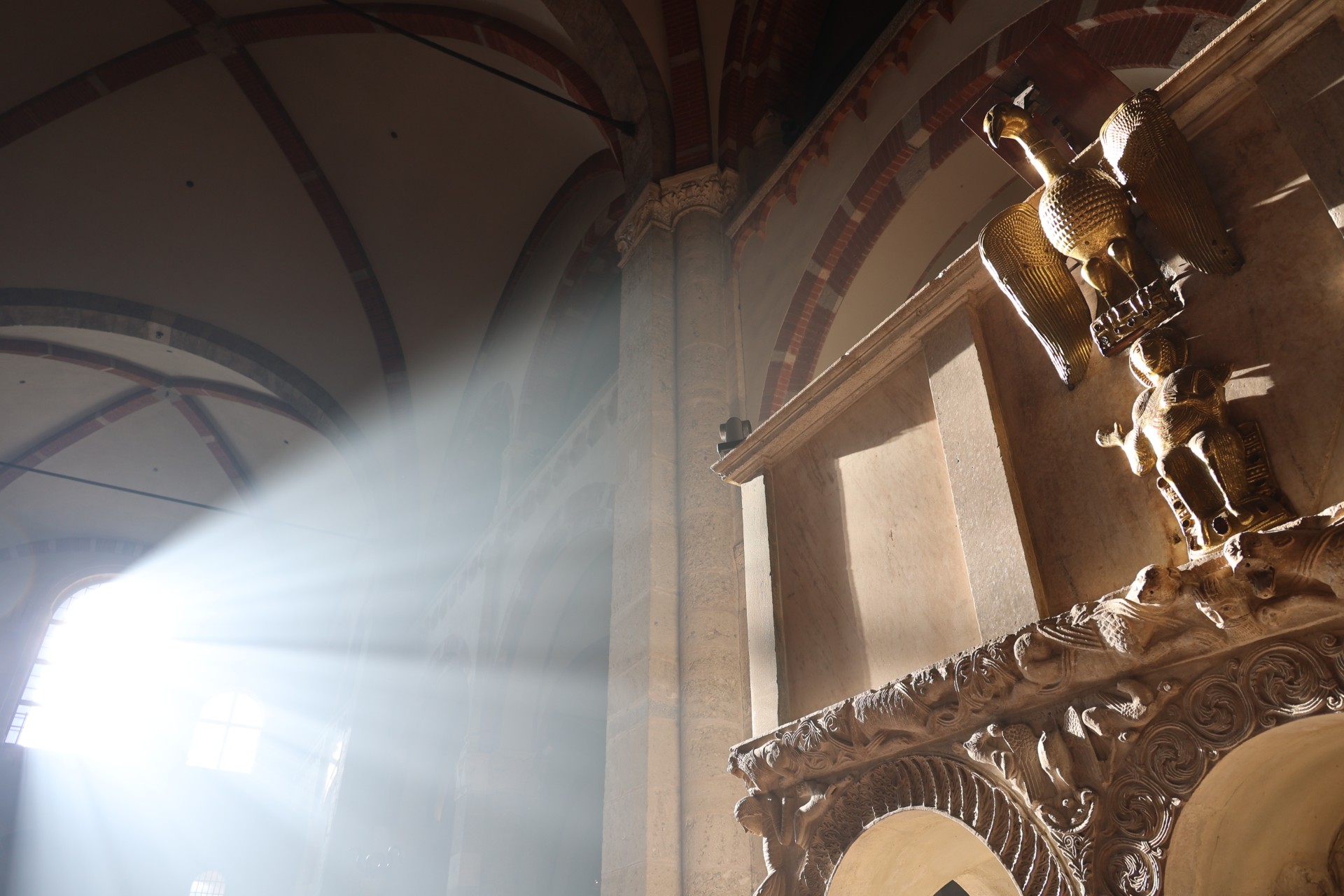
This sudden turn around in the story is well illustrated in Tolkien’s ‘Lord of the Rings’, and many will have read the book or, at least, seen the movie’s various scenes in which the Great Eagles swoop in and save Gandalf from the top of Orthanc, or carry off Frodo and Samwise from Mount Doom, or turn around the final battle in the ‘Return of the King’. The eagle, then, becomes the instrument of the eucatastrophe in Tolkien’s writing; they are a symbol of divine grace, of God acting to save us from sin and destruction, as he has by Christ’s Incarnation and Rising from the dead.
The reason Tolkien chooses an eagle as, effectively, the instrument of saving grace and a sign of divine providence may come down to the verse we read today from Exodus in which God declares to Moses: ‘You yourselves have seen what I did to the Egyptians, and how I bore you on eagles’ wings and brought you to myself’ (Ex 19:4). Indeed, the eagle has long been considered the most noble of birds, and closest to the divine – it is rich in symbolism. In ancient Babylon, for example, the eagle was believed to carry souls to heaven, and the Phoenicians believed the eagle to be a sign of a god who conquered death. The eagle was believed by the Greeks and Romans to fly close to the sun and it was able to look directly into its light, and if it were burnt by the sun, it could dive into the waters to regenerate itself. Christians thus said the eagle was a symbol of St John whose Gospel opens by soaring to the heights of the divine nature of the eternal Word, or of the Christian soul regenerated by the waters of Baptism. Indeed, as the eagle was king of the birds and associated with new life, so some also likened it Christ himself.
But if we consider what it means for God to say that he bore us up on eagle’s wings, or that he would refresh us such that we can ‘mount up with wings like eagles’ (Isa 40:31), the imagery speaks of power and swiftness. As such, God’s providence coming to rescue us in our direst need is both strong to save and swift to act when we most need it. We are invited, then, to believe and trust that in the end there will be a eucatastrophe for us who, as St Paul says, ‘have been justified by [Christ’s] blood’. For by Christ’s resurrection, by his life, we shall be saved, and can ‘rejoice in God, through our Lord Jesus Christ, through whom we have now received reconciliation’ (Rom 5:11). Thus in the book of the Apocalypse, the woman who gives birth to the male child, who is a symbol of the Church, is ‘given the two wings of the great eagle that she might fly from the serpent into the wilderness’ (Apoc 12:14) to be nourished by God. And then in Matthew 24:28, Christ says that ‘Wherever the body is, there the eagles will be gathered together’, a tantalising image, perhaps, of the Eucharist, his Body, nourishing the eagle-winged members of the Church who have been rescued from sin by God’s mighty grace, brought away into the wilderness so as to be taught and fed by God as his ‘treasured possession’. So, just as God’s People first received the covenant and learnt God’s ways in the wilderness, so has God rescued us from the snares of sin by his grace, so that we can in the wilderness of this our present life become ‘a kingdom of priests and a holy nation’ (Ex 19:6).
Hence Tolkien observes that in this life ‘the Christian has still to work, with mind as well as body, to suffer, hope, and die; but he may now perceive that all his bents and faculties have a purpose, which can be redeemed.’ Living in this fallen world but with the hope of the resurrection, of the great eucatastrophe, we thus ‘proclaim as you go, saying “The kingdom of heaven is at hand’’’ (Matt 10:7).
Readings: Exodus 19:2-6 | Romans 5:6-11 | Matthew 9:36-10:8
Image courtesy of Fr Lawrence Lew OP

Rudolf Carpanini
Very interesting, Father. You have illuminated us and given us much to ponder.
Luke Richards
A wonderful reflection, thank you Fr 🙏
Ian Campbell
A rich and beautiful meditation. Thank you.