Children Before God
Twenty-fifth Sunday of the Year. Fr Robert Verrill preaches on the parable of the labourers in the vineyard.
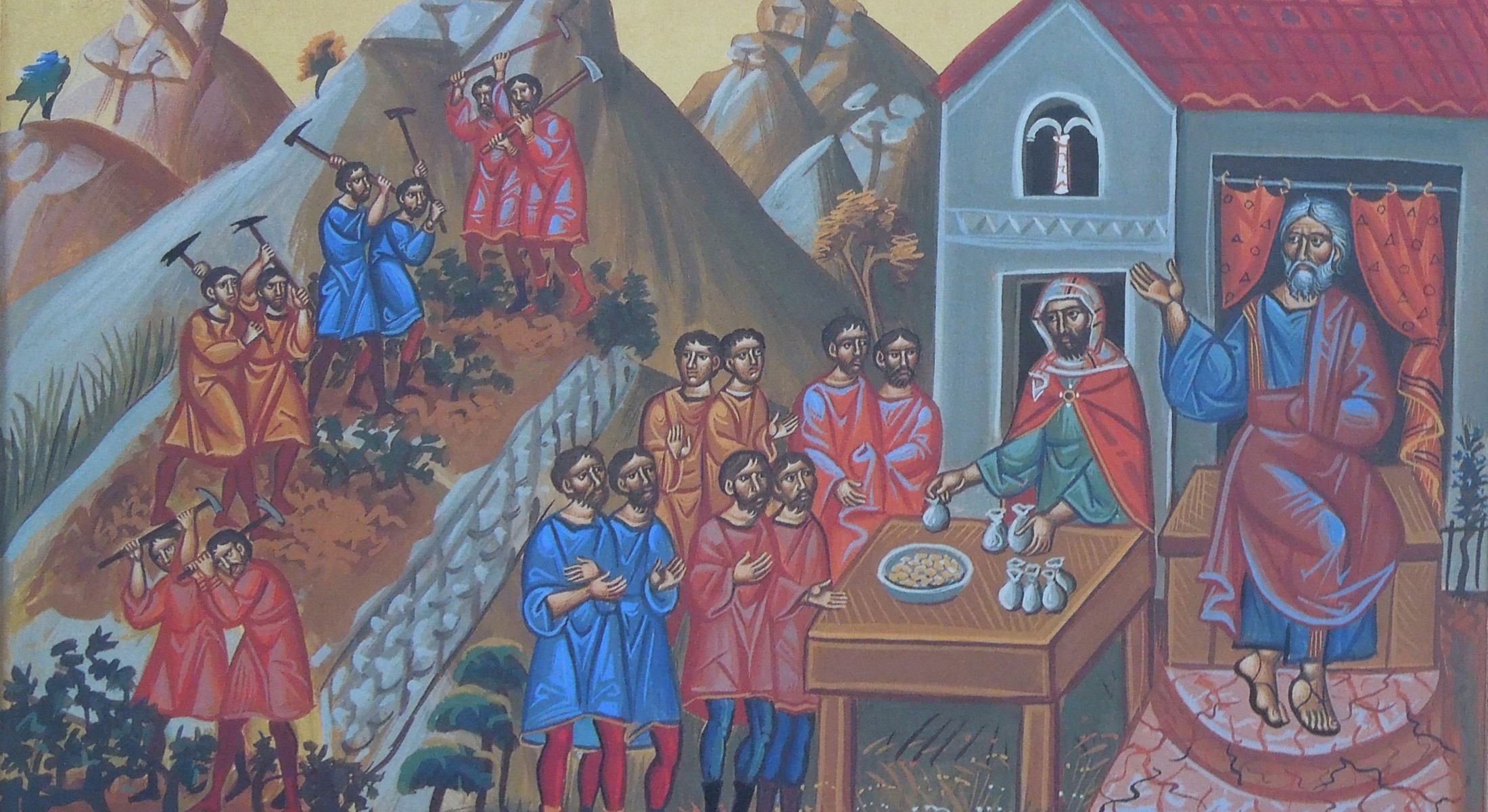
Most of us at some point in our lives have to go through the ordeal of looking for work, and usually this requires a lot of effort. We have to do our best to make a good impression and show ourselves to be motivated and sufficiently skilled. No employer is going to give us work if we come across as being idle. But it is just such people that the landowner in today’s parable is so willing to employ. What is even more surprising is that at the end of the day, the landowner gives all the workers the same wage. What is going on?
I think the key to this parable is what the landowner says to the disgruntled labourers who worked all day and got the same wage as those who had worked only one hour. He says ‘Am I not allowed to do what I choose with what belongs to me? Or do you begrudge my generosity?’
So the landowner is being generous. Our Lord, like the landowner, does not ask us to work for Him because we are particularly skilled or motivated. Neither does He invite us to work for Him because He has any need for us. Rather He offers us His invitation because we need Him. Thus, His invitation to work for Him is an expression of His goodness which He so freely pours out onto our humanity.
As an analogy of what is going on, we can think of a mother who asks her child to help her make a cake. If she doesn’t ask her young child to help, she can work very quickly and efficiently. But when she asks the child to help, things aren’t so simple. Maybe the child drops an egg, perhaps cake mixture gets everywhere. The child might think he or she is doing a great job of mixing the ingredients but be oblivious to the fact that mum is holding onto the end of the spoon and doing most of the work. So it’s not very efficient. But the whole point of making cakes is that it’s not meant to be efficient. Rather, it’s all about love. The mother could express her love for her child simply by making the cake without asking the child for help at all, but by asking the child to help, the bonds of love between mother and child grow even stronger.
It takes a great deal of humility to realise that we are all children before God, but the more we do so, the more we become open to that divine love through which everything comes into existence. It’s a great surprise to realise that God is inviting all of us to help Him in His work of salvation and to share in His divine life. But this is what it means to be Holy – to share in the life and the work of God. And the source and summit of our share in the life and work of God is to be found in our participation in the Eucharist. Indeed, the Eucharist gives us a perspective on our lives in which we can see God working in us and through us.
In today’s Gospel, the vineyard workers had been raised up from their idleness to produce a drink which the psalmist approvingly describes as gladdening the heart. Making wine is certainly a worthwhile enterprise!
But how much more should we recognize the value of what we are doing in our daily work when we understand it from a Eucharistic perspective! For when we have a Eucharistic perspective, we can recognize that in our daily work we are engaged in more than a merely human enterprise. For in the Eucharist, God takes the fruit of the earth and the work of human hands and transforms them into a sacrificial offering in which we participate in the death and resurrection of Jesus Christ. And so when we let our Eucharistic participation shape our daily lives, we can see the burdens of the day as continuations of Christ’s sacrifice – as opportunities to manifest the sacrificial love of God in our world. This is the perspective that the Eucharist cultivates in our lives.
God has raised us up out of our idleness and given us the dignity of working in His vineyard and of bearing the fruit of His eternal love. And this is a gift for which we should always be grateful.
Readings: Isaiah 55:6-9 | Philippians 1:20c-24, 27a | Matthew 20:1-16
Image: icon of the parable of the Labourers in the Vineyard by ted (CC BY-SA 2.0)