Knowing and Being Known
Thirty-Second Sunday of the Year. Fr Toby Lees preaches on the parable of the wise and foolish virgins.
If you’ve ever bemoaned the amount of effort that goes into planning a wedding; be grateful you didn’t live in first century Judea. A Jewish wedding had three movements. First came the betrothal, those vows Mary and Joseph had exchanged before she conceived by the Holy Spirit, which made a couple legally husband and wife, though they did not yet live together or consummate the marriage. Then the bridegroom went away to prepare a home and a feast. The second movement was the procession and ceremony, the groom going to the bride’s house to lead her out into her new home, and then immediately followed the third movement, the feast. And what a feast it was when it came: seven days, with a guest list that would make even the biggest English weddings seem small and intimate.
Today’s Gospel finds us on the cusp of the feast, the groom inexplicably late for the procession from the bride’s house. It is midnight and everyone is now asleep. And five of the bridesmaids discover their oil has run out.
We aren’t told why. Perhaps they forgot, or never thought they’d need it. Here’s a modern equivalent: a groomsman is driving some of the lads to the reception, with just enough fuel for the journey. He thinks about factoring in some extra time to stop at the garage, but the football is on, it’s a cracking game, and it’s close. It’ll be fine. But then’s there’s more injury time than normal. Still, it should be okay. But, then comes a diversion, and fifteen miles becomes twenty, and then there’s the traffic and the engine starts to splutter. He rings the car behind: sorry, mate, we’ve got to go on, and nobody has a tube to siphon with. In any event, they miss the wedding. Five-star hotel, open bar, their friend at the altar, and the football, so vital an hour ago, now means nothing. They know they chose wrongly, they regret their choice, but it is too late.
I suspect many of us fall into the same trap. I’ll make the right choice when it really matters. There is something important, something we will certainly do, but not just yet. So we do something easier, or more instantly rewarding, and then something urgent crops up, and we find the thing that mattered most has been left undone, and we’re past the point of no return.
But beyond this simple, but still very true message, of ‘do not put off til tomorrow what can be done today’, there are elements to this story which should trouble us as Christians and cause us to go deeper.
First, the wise bridesmaids refuse to share their oil. It seems ungenerous; we expect better of the wise. Surely Jesus should chastise them as selfish? But what might the oil stand for. Well, some in the tradition have read the lamps as the visible flame we carry of our good works, and the oil as charity, the love that feeds it. And the problem is that you cannot lend someone your love of God. Nobody can be in a relationship on another person’s behalf.
Second, and more chilling: the bridegroom at the door says, ‘I do not know you.’ Faith and good works, if it is only a lamp held in the hand, can be a notional assent: yes, Jesus existed; yes, I believe what the Creed says. Yes, I’ll do what he says I have to. But charity is entering into a relationship. It is the difference between knowing about someone and knowing them, between the knowing and keeping the law, and knowing and loving the giver of the Law.
And the language of knowing in the Bible carries real intimacy. When Scripture says Adam ‘knew’ his wife, it doesn’t mean he was familiar with her CV. To know, in the biblical sense, is to give oneself and to be known in return, it’s a euphemism for the marital act. So when Christ says ‘I do not know you’, it is not the verdict of an official checking a list. It is perhaps the saddest sentence in the Gospel: that a person might spend a lifetime near the light, having kept the law, and never actually having loved.
That is why the oil cannot be borrowed. This is the relationship we are called into, and nobody can do it for us: not our parents, not our parish, not even the wisest bridesmaid in the queue.
The oil costs nothing but our attention: prayer, the sacraments, reading the Scriptures attentively, not just dutifully, the small unseen acts of love. The Bridegroom has been patient; it is we who keep saying ‘later’, and it is tragic.
Readings: Wisdom 6:12-16 | 1 Thessalonians 4:13-18 | Matthew 25:1-13
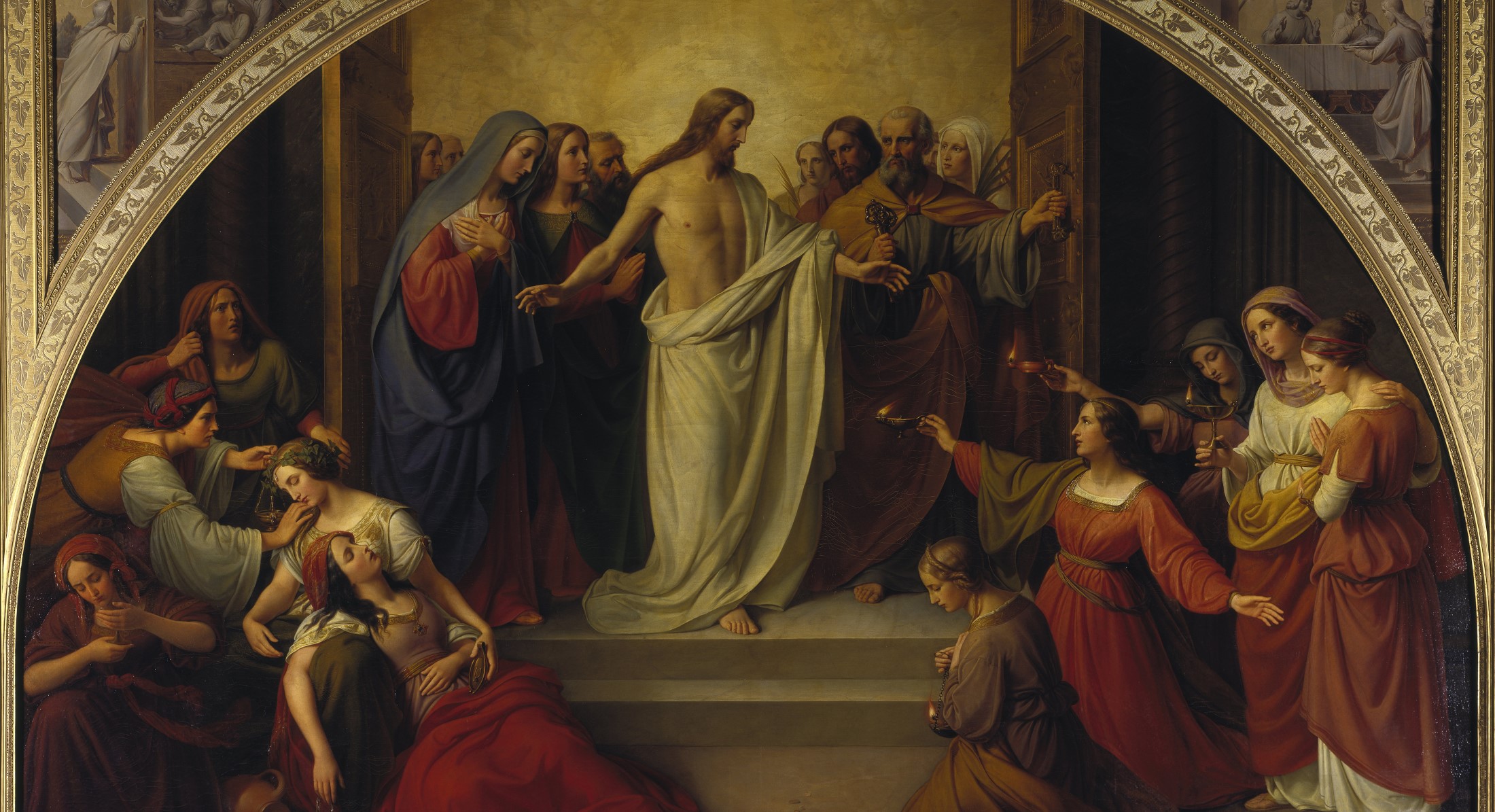
Image: Das Gleichnis von den klugen und törichten Jungfrauen by Friedrich Wilhelm Schadow (public domain)