Our Only Lord
Twenty-Ninth Sunday of the Year. Fr Richard Finn preaches on the question of paying taxes to Caesar.
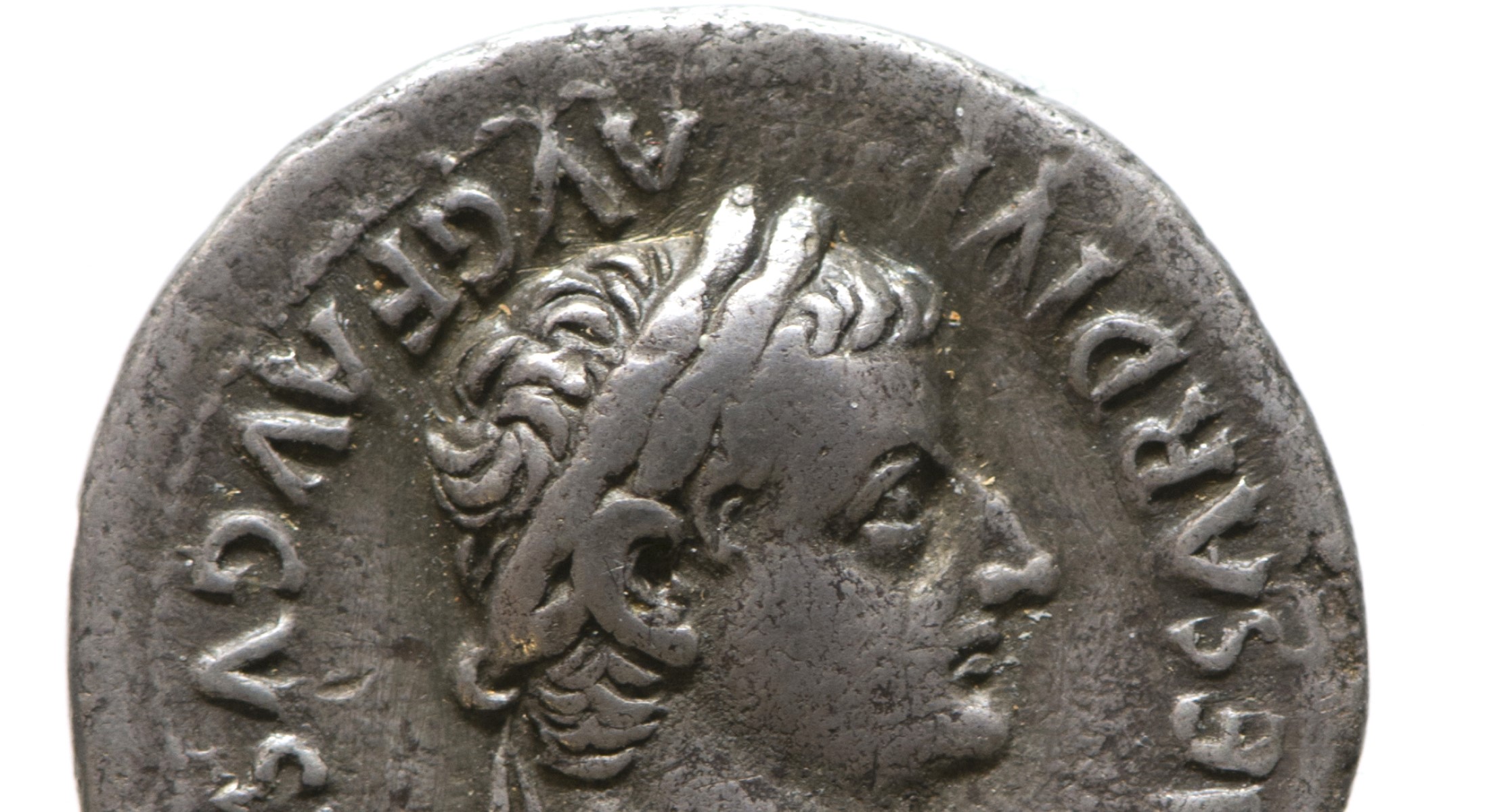
The Pharisees try to entrap Jesus. Whichever way He jumps, He’s caught. In His world, the coins you use name the power you serve. A denarius struck in the reign of the Emperor Tiberius portrayed his head crowned with a laurel wreath, the mark of military victory. It named him as Caesar, and proclaimed him high priest of Rome, Pontifex Maximus, son of the divine Augustus. If Jesus declares that it is wrong to pay tax to Caesar, because Israel is properly God’s kingdom, not Caesar’s, Jesus will incur the wrath of the authorities. If Jesus says that one may pay Caesar’s taxes, He will be held to have betrayed His Israelite identity, become complicit in idolatry. And this trap is no game: it’s murderous. It may result in his arrest and execution, or his being lynched by the mob. Ironically, the other side of the coin probably showed Livia, Tiberius’ mother, personified or deified as the Roman goddess of ‘Peace’. So duplicitous is our fallen humanity. State violence that enriches the few masquerades as peace for the impoverished multitude.
Yet Jesus escapes the trap. In fact, He turns the tables on his opponents. They are the ones with Caesar’s coins, who therefore accept Caesar’s rule. So, they should give back to Caesar what they have taken from Caesar, in that sense give Caesar what belongs to him, and to God what belongs to God, but the answer is deliberately ambiguous about whether what Caesar is to be given back is a tax that acknowledges Roman rule over Israel. Jesus attacks the hypocrisy which blinds the Pharisees to their own accommodation with the authorities, while they seek to condemn others for any accommodation on their part.
Jesus’s answer has reverberated across the centuries. For we are the coins that bear His image and likeness. All that we are, all that we have, is first and truly God’s. We belong to Him and not to Caesar. What is it, though, to belong to God? To be God’s possessions? Where Caesar’s lordship diminishes His subjects’ freedom, may lead to enslavement and death, God’s reclaiming of us makes for our freedom from sin and death, leads us from slavery into adoption as sons and daughters of God in Christ. As such, by the gift of the Holy Spirit, we share His love for what is good and true.
That must condition all that any Caesar may ask of us. Certainly, no ruler, no state, can simply identify their policies with God’s will; they cannot claim God’s authority for whatever the state may purpose. Our faith thus necessarily makes us opponents of totalitarian rulers and their wars of aggression. Nor can we accept attempts to make the Church subservient to the State, as happened in the Henrician reformation. Perhaps that’s obvious, but it is easy to forget that secular democracies may be equally over-bearing, bring in laws that cut across our prior obedience to God and His righteousness. More insidious still, societies may collude in defining the ‘rational’ options, the ground of intelligent debate, so as to exclude as irrational our faith-perspective. Caesar doesn’t just strike the coins, print and perhaps guarantee the currency used in the markets; a state and its culture may lay claim to the currency of ideas. One of the things that Dominicans are meant to do within the Church is to critique this currency of ideas, to clarify and uphold the values and understanding carried by the Church. Our faith should make us sharp, perceptive critics of the culture in which we live, whenever its ideology lays a false claim to our respect, would command our thoughts, our assent to its half-truths and euphemisms through its pervasive presence in the media.
On the other hand, what Jesus says here is no charter for disengagement, for ghetto-Catholicism. To be human is to be sociable and within a society that must subordinate personal freedom to the common good. Furthermore, to be human in a fallen world is necessarily to belong to a society in which unjust individuals and factions must be constrained through force, and force which is exercised by those who are themselves imperfect instruments of justice. We have to work out what we owe such regimes, and also what opportunities they offer us.
It’s worth reflecting from this perspective on our reading from Isaiah. Cyrus, King of Persia, built one of the greatest empires of the Ancient Near-East. His war-machine was matched by a shrewd politics which rewarded all those who cooperated with him. As one small part of this policy, Cyrus allowed the exiled Israelites to return home from captivity in Babylon. That’s why Cyrus turns up, perhaps to our shock, as the Lord’s ‘anointed’!
What does that mean? Isaiah doesn’t sanction Cyrus’s wars and power-politics; he doesn’t bless the lethal violence that oils the wheels. But Isaiah shows the power of God to bring good even out of evil, and asserts God’s providence that none can frustrate. God is not trapped by our murderous games. Just as Jesus was not trapped by a trick question. It may be extremely hard for us to know in a given time and place what belongs to God and what to Caesar; but God knows, and works in us; He graces us. If we rely on His providence, seek out His wisdom, He will lead us into that paradise where there is no gap however small or minute between what is God’s and what is Caesar’s, because there God Himself is sole king.
Readings: Isaiah 45:1, 4-6 | 1 Thessalonians 1:1-5b | Matthew 22:15-21
Image: part of the obverse of a denarius of Tiberius,with the inscription ‘TI CAESAR DIVI AVG F AVGVSTVS’, from the Yorshire Museum, via Wikimedia Commons (CC BY-SA 4.0)