The Divine Wedding
Twenty-Eighth Sunday of the Year. Fr David Goodill preaches on the parable of the King’s Wedding Feast.
There is a lot at sake with the wedding feast in today’s Gospel. Weddings are important occasions and, although the number of marriages has declined over the last few decades, people continue to celebrate weddings as big events. Not only is this a most important day for the couple getting married, but there are wider relationships at play, as the friends and the families of the bride and groom are linked through the couple’s commitment.
Yet we may still be left puzzled at the extreme reactions that the wedding feast in the parable provokes. The King sends out his servants and when they are not successful he sends out a second group of servants. Things then get out of hand when the people seize the servants and kill them. Now the king responds by destroying the murders and burning down their city. Why so much violence over an invitation to a wedding feast?
The background here is the use in Scripture of marriage as an image of the relationship between God and the people of Israel. Jesus is drawing upon a rich heritage that describes the relationship between God and Israel as one of intimate union and love. Reactions are strong because of the strength of that relationship and the damage that is inflicted when it is betrayed. The people do not wish to share in the wedding feast of the King’s son and this represents the betrayal of God’s love for his people.
We tend to look at weddings through our modern lens as primarily private affairs that concern a particular couple and by extension those related to them. Here the essential nature of marriage as founded on the free consent of two individuals is given expression, but what is lost is the role that marriage plays in society. Marriage is a personal reality for the couple who marry, but it is also a social reality, forming the basis for society. This is why marriage is seen traditionally as a religious event. Religion binds us to God and binds us together. It is founded on the truth that we are made for communion with God and binds us to God with acts of worship and devotion that also bind us to each other in mutual love and respect.
Those who refuse the invitation to the wedding feast are doing more than turning down an occasion for a party, they are denying their own happiness. Without God there is no true happiness. In the parable those who refuse the invitation either go off to be busy with their own affairs or remain to kill the king’s servants. They are not having a good time! Without God we end up caught up in ourselves or fighting God and his servants. The decline of religion in modern societies has not brought about the promised liberation of humanity, but a fractured world where many people young and old experience loneliness, and anger resounds on social media.
The king does not give up, but sends his servants out to invite as many people as they can find. This is the mission of the Church today, to proclaim to all people that God the Father is calling them to the wedding feast of his Son. We are not alone in this world and there is an answer to our deepest desires. We are made to love God and we enter into union with him through sharing in the marriage feast of the Son, the sacrament of Holy Communion through which we are united to God and to each other.
The final part of the parable is in many respects disturbing. Again, there seems to be an unwarranted reaction to something we might put down as a simple mistake or at worst a lack of due consideration, as when someone turns up for a funeral dressed inappropriately. The wedding dress expresses more, however, than a fashion choice. It is being rightly prepared to receive God’s Son, a gift of grace that we receive from God through the power of the Holy Spirit. Our preparation to receive the body and blood of Christ through baptism, where we are anointed, clothed and enlightened by Christ.
Readings: Isaiah 25:6-10a | Philippians 4:12-14,19-20 | Matthew 22:1-14
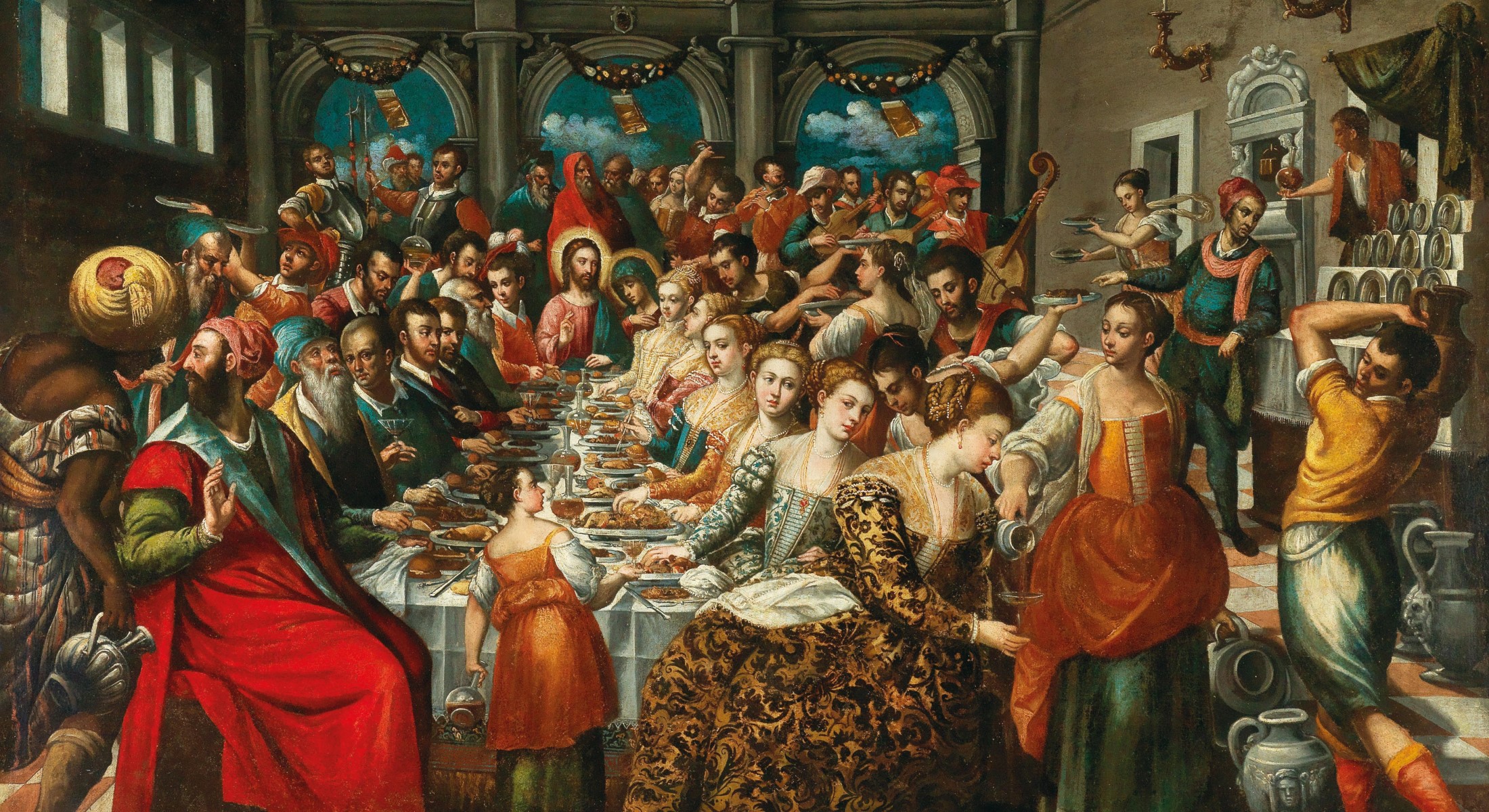
Image: The Wedding Feast at Cana, attributed to Michael Damaskinos (c. 1570, public domain)