Their Loving Gaze
Solemnity of All Saints. Fr Dominic White reminds us what heaven really means.
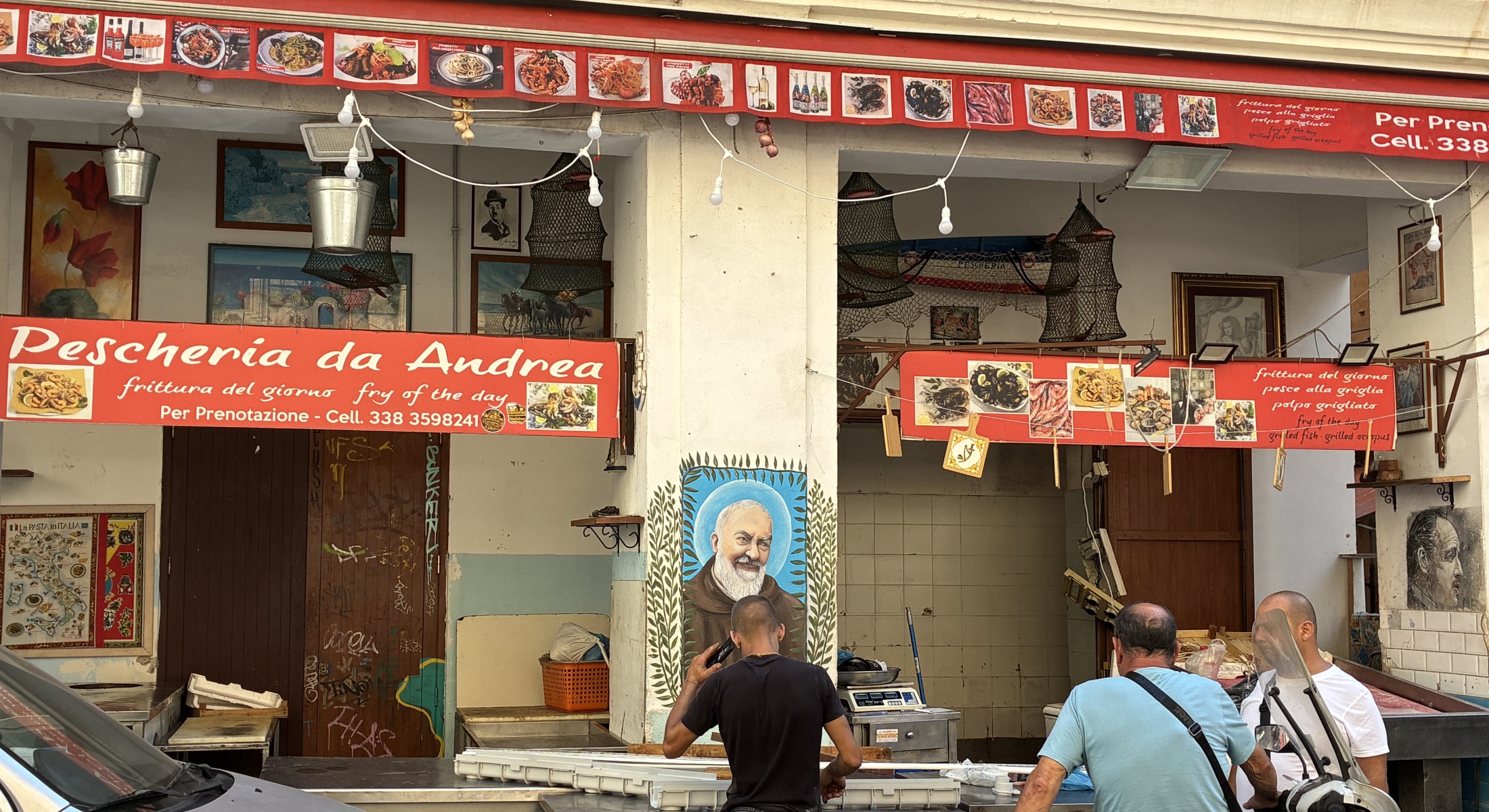
I had the great blessing in summer to visit Palermo for the priestly ordination of our Sicilian brother Giovanni, who did his studies here with us in Oxford. Near the Dominican church in Palermo is the famous Vucciria market. Vucciria is a Sicilian word which apparently means noise and chaos. A fair description: the market is not chi-chi repackaged in international tourism style, rather, it’s chatty, bustling, full of everyday plastic chairs, and at night it gets louder still as a destination for outdoor dancing. On the wall of the fish stall is painted a little fresco of Padre Pio.
Padre Pio, or St Pius of Pietrelcina, to give him his proper title, is not especially associated with fishing or markets, though he’s a very popular saint in Italy, and indeed all over the world, for his many miracles. He’s dear to me as I was ordained priest on his feast day. So what’s he doing in the fish stall? The cynics might see him as taking over from the pagan household gods, guarding the place against bad luck. But cynicism doesn’t make you many friends – and the wonderful news is that the saints are our friends.
The saints are not far away, because heaven’s not ‘up there’ or ‘out there’ like some parallel universe of science fiction. The heavens are the depths of reality, into which St John saw in the Revelation God gave him. This was on the Lord’s Day, and it may be that what we have in all the liturgies in the Book of Revelation is actually a description of the Sunday Mass at which St John was present. ‘In the spirit’ he saw deeper in, saw the countless multitude of saints, including the martyrs buried under the altar (as in the catacombs, altars were often built over the tombs of the martyrs). The saints are in fact all around us, present in spirit – that’s the invisible reality the artist of the fish stall revealed, consciously or unconsciously. Especially in the Mass, when we invoke the intercession of the saints in the Eucharistic Prayer, perhaps adding the patron saint of the parish or the saint of the day, we celebrate being part of this great community of the Church which exceeds this earth, is infinitely greater than the here and now.
These are the holy ones: personalities as diverse as you can imagine. Some would have loved to dance in the noise and bustle of the Vucciria market and others would rather have been quiet at home. Some are famous saints like Padre Pio, working miracles and suffering daily in their bodies the pain of the Lord’s Cross in the Stigmata; others are people whose extraordinary holiness was known in this life to God alone, and was only revealed after (St Thérèse of Lisieux), or we may know only in the next life. But they have all washed their robes clean in the blood of the Lamb and probably known in equal measure struggle against their false self and against the injustice of the world, and a beautiful peace and delight in their fellow human beings and the beauty of creation. They have known often the comforting presence of God, and in other times lived in darkness and ‘full oft have striven with the God they glorified,’ in the words of Walter Frere’s hymn. Some were martyrs, others teachers, farmers, artists; married lay people and monks and nuns; intellectuals and ‘doers’; rich and poor; some holy all their lives, others converts from wickedness, most perhaps somewhere in between.
What unites them all, in their diversity, is that they have lived the Beatitudes, Jesus’ paradoxical teaching which deepens the Ten Commandments and reveals the beautiful challenge, the glorious, transformative battle of the Christian vocation. What Jesus says is extraordinary: that the poor in spirit already own a kingdom, that the meek will inherit the earth (so not the dictators, then?), that those who hunger and thirst after righteousness will in fact be satisfied, that the merciful will receive mercy in return (not ill-treatment); that the peacemakers will not be told to shut up and go home, but will be called sons of God (to be a son meant to inherit everything your father was and is); that the pure of heart will see God; and that being persecuted on Jesus’ account is actually a cause of rejoicing because our reward is great in heaven.
Does this sometimes feel like ‘pie in the sky’, or a holiness only for the spiritual athletes of the Church? What tells me that Jesus’ paradoxical words are true, that this challenge is worth taking up, is the loving gaze of holy people. St John teaches us in today’s Second Reading, ‘when he appears we shall be like him, because we shall see him as he is.’ In a world marked by so much talent and possibility, yet so much loneliness, even now, in this life, we get a transformative glimpse of Jesus’ loving gaze in the face of people who perhaps do not always even recognise it in themselves. There is something in common between the image of Padre Pio, looking out on the noise and bustle of the market, and the grace-filled way the pure of heart gaze as they contemplate the image and likeness of God in their neighbour’s face, perhaps even the most unlikely people, such as the contemplatives of Death Row (or ‘Light Row’, as they prefer to call it), chaplained by nuns in a US prison.
There is, as we have heard, that great multitude of saints in heaven that no one can number. And the ‘saints next door’, as Pope Francis loved to call them, those holy people around us (not always easy, not always right, but always communicating God’s love to us). And if we see holiness in our friends and parish community, even in ourselves, let’s be grateful and wonder. But let’s not be surprised. Because our vocation is to be, all of us, saints.
Readings: Revelation 7:2-4, 9-14 | 1 John 3:1-3 | Matthew 5:1-12a
Image: photograph of Vucciria Market, Sicily, (c) Dominic White OP (all rights reserved)