The Talents that Matter
Thirty-Third Sunday of the Year. Fr John Patrick Kenrick preaches on the true meaning of the parable of the talents.
Some years ago a Christian group in another country wanted to produce a document about capitalism and the bible. Financial experts were engaged to write it. Unfortunately, they knew more about investment than about scripture and they had the brilliant idea of using today’s parable, which they claimed, is proof that God is urging us to invest our money wisely on the stock market so that we make a profit. Oh dear! How easy it is to misinterpret scripture when you blithely ignore Catholic tradition. Of course, they had missed the point entirely. As most Christians know, the gospels warn us repeatedly about the danger of accumulating wealth.
It’s true that superficially this parable is about investing money. In those days a talent of silver was a huge sum of money to most people, roughly equivalent to 20 years wages for an ordinary labourer. But if we want to understand the meaning of this parable it is important to see it in context. All three parables in chapter 25 of Matthew’s Gospel point to the second coming and the final judgement, and all three are concerned with the purpose of our lives. We are being reminded to live in such a way that we are prepared for that final judgment. So how then do we prepare?
Today’s first reading gives us a clue. The reading from Proverbs praises the perfect wife for her industry and skill. That’s not surprising but she is also praised for something less obvious – her generosity to the poor. The greatest accolade comes in the verse ‘a woman who fears the Lord is to be praised’.
St Paul tells the Thessalonians today that ‘you are all children of light, children of the day’. It would be a mistake to take this for a simple expression of praise. The theme of this passage is the Lord’s return as judge of the world. In this context it is surely a reminder that the children of the light have no excuse not to prepare for judgment. From those to whom much is given, much will be expected.
The Gospel illustrates this point. The returning master is delighted that his first two servants have doubled his money. The Parable of the Talents, is a reminder that we Catholics, priests and preachers especially, should not be complacent about the gifts entrusted to us. The parable suggests that God gives graces in proportion to our ability to use them. The wicked servant fails to make even the smallest return on his master’s investment which, as the Master points out, would have been child’s play and would have been enough to satisfy him. So then what are these gifts?
Although we derive our word talent, meaning a particular skill, from this parable Jesus has in mind not these natural abilities but rather the God given graces we receive as believers. Not everyone receives the same spiritual gifts or in the same measure; but we are all expected to make use of our gifts, as St Paul reminds us in chapter twelve of his letter to the Romans.
When it comes to assessing our spiritual gifts it is easy to make the wrong assessment. God knows us better than we know ourselves and He gives us exactly the gifts that we can make use of. More might be more than we can handle. The great saints remind us that along with great graces come great trials. There is a good reason for trusting in divine providence.
Like the perfect wife, we may be given natural gifts too. But a natural skill is only of value in God’s eyes if we make use of it for His glory. Christians should not waste their lives in seeking fame or social approval. The only lasting joy comes from doing the will of God. Those who are blessed with exceptional natural skills should still give priority to the all-important task of communicating the faith. Every baptized Christian is given the grace to share their faith with others – in different ways and to varying degrees. What we must not do is to assume that the gift is just for us – for then it will lie buried and on the day of reckoning we may have no evidence to prove that we have followed Christ and shared his teaching, and then be unable to ‘enter into the joy of our Master’.
Readings: Proverbs 31:10-13, 19-20, 30-31 | 1 Thessalonians 5:1-6 | Matthew 25:14-30
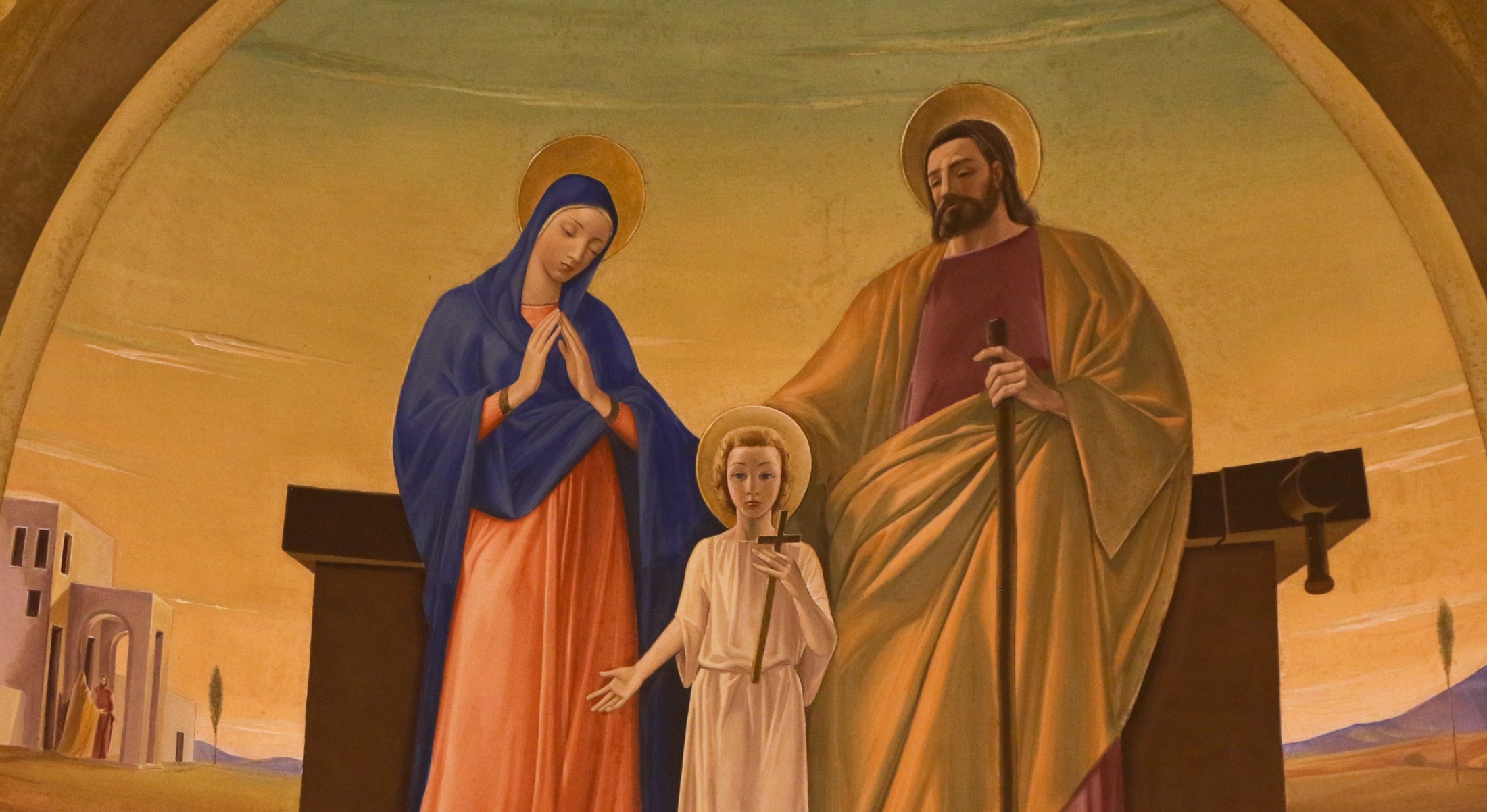
Image: painting from the apse of the Church of St Joseph, Nazareth, photographed by Fr Lawrence Lew OP