

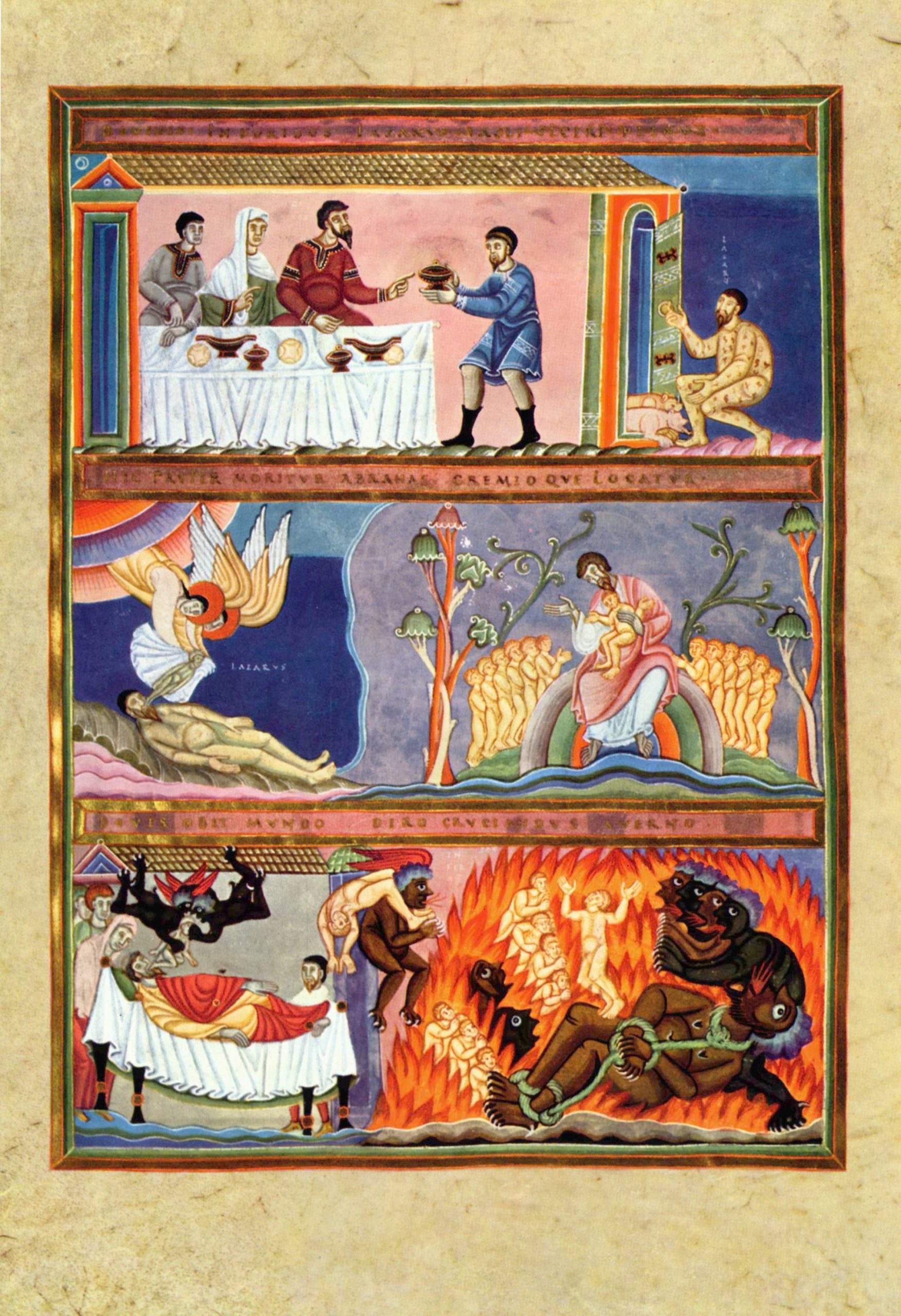
In His Riches, Man Lacks Wisdom
In his life of presumption and hoarding of wealth, the rich man perhaps forgot to look to heaven. Might he be a mirror for us?
The following homily was preached to the student brothers during Compline. You can listen here or read below:
Reading: Luke 16:19-31
There’s the story of a man who lived for about 1,500 years who eventually meets death after an accidental falling of the roof on his head. And Death comes to greet him and he says, “Oh, surely this isn’t how I die.” And Death says, “Well, I’m afraid this is it.” And he says to death, “Well, I guess I’ve done all right. I’ve had it better than most people, haven’t I?” And Death says to him, “You lived what anybody gets, a lifetime. No more, no less, a lifetime.” And he dies resigned to his fate, surprised by death despite having such a long life.
I wonder if our rich man today in this Gospel was also surprised by death. In his life of presumption and hoarding of wealth, perhaps he forgot to look to heaven.
In a sense, he can become a mirror for us. The times when we seek perpetuity over eternity; where we despair of heaven and so settle for the goods of earth, an illusion flattening our hope to this world.
CS Lewis says that “we are like half-hearted creatures fooling about with drink and sex and ambition when infinite joy is offered to us, like an ignorant child who wants to go on making mud pies in a slum because he cannot imagine what is meant by the offer of a holiday at the sea. We are far too easily pleased.”
Sin is a rather irrational thing. We get caught in cycles of sin. We cope with pain by sinning. And sin makes us believe that we’re not worthy of repentance. And yet, we become entitled, we demand the goods of this earth on our own terms, and it causes indifference. At the end of all this, we get stuck in a cycle of futility. This futility further fuels our entitlement and gives us anger. Not able to metabolise this futility again, we turn to sin, and ironically, this becomes our master, and it infiltrates every part of us. The cycle of sin confiscates our eternal purpose and our heart that longs to love. When futility is not addressed, it taunts us and it says that we cannot change and we are beyond repair. Or so it seems. Instead of transforming, we collude with it and choose indifference: indifference to God, indifference to the damage it does to our hearts. And indifference to the man who sits at our table in need.
Why have I become so resigned? Why have I believed that hope is pointless? Why do I delay? I’m sure, brothers, that we’re familiar with that thought in our head that says, “it’s fine. I’ll do better after I’ve gone to confession next week, perhaps.” Or that voice that tells us, “Oh, I’ve already confessed this. Um, my next confession’s in a couple of weeks. It doesn’t matter too much. It’s only a venial sin.” But these matter.
What are we to do in this state of resignation and futility? Perhaps Lady Continence, as she spoke to St. Augustine, can speak to us. “Can one or other do it of themselves, and not rather in their Lord, their God? The Lord their God gave me unto them. Why do you stand in your own strength and so standest not? Cast yourself upon Him. Fear not. He will not withdraw that you should fall. Cast yourself upon him without fear.” And Augustine writes, “And I blushed beyond measure, for I still heard the muttering of those toys and hung in suspense.” And she again seemed to say, “Shut up your ears against those unclean members of yours upon the earth that they may be mortified.”
Brothers, this is what Lent is about: the changing of our minds With prayer, humility, and with grace, we come back to ourselves to recognise the depths into which God’s mercy and redemption have to dwell. With fasting, we mortify those desires which anchor us to this earth and stop us from looking to heaven. And with almsgiving, we open up our hearts. Indeed, Lent is about expanding our imagination. It’s about expanding our minds and expanding our hearts.
Christ says in the Gospel that even if one were to come back from the dead, they might not listen. It’s true. In faith, we know that Jesus did come back from the dead. And yet, we still sin. We are like the brothers of the rich man, knowing that Christ is risen and stuck in cycles and patterns of sin.
This Lent, dear brothers, let us pray that we will be converted so that when Easter comes, we will not be remaining in closed hearts, in entitled attachment, in futility and resignation, but come to dream of heaven. So that when death does come, it will not catch us by surprise, wanting more time to sort things out. But rather our lifetime may give way to timeless life in the bosom of our God.
Amen.
Image: Parable of the Rich Man and the Beggar Lazarus (c. 1035-1040), illuminated manuscript, Codex Aureus Epternacensis.




Gurpreet kaur chadha
What an awesome choice of words and we mere mortals are left to ponder.Thank you ,Clementine
Sylvi
Thank you, Br. Herbert, for your message on Lazarus and the rich man. I remember seeing you grow up in church—now seeing you serve in ministry is a blessing to your parents and our community. God bless you. 🙏
Thanges Gengadharan
It’s wonderful to hear this mortal speech.
It’s wake us up and says about real life.
Thank you Clamantine
Peggy
Good Morning Clamatine
Very interesting.
Sometimes we go to confession but repeat the same sin. Gossiping. Saying bad things of others but still do not repent.
Sometimes it can be difficult in this modern day environment but we have to thrive & do our Best especially now during Lent. An opportunity to ask GOD for forgiveness and try our best not to repeat our sins again & again. AMEN