

A Marian Feast and a Marian Fast
Good Friday. Fr Euan Marley relates today’s commemoration to the Feast of the Annunciation.
The poet John Donne wrote a poem entitled Upon the Annunciation and Passion Falling Upon One Day, 1608. The coincidence occurred again most recently in in 2016. Donne is referring to a trick of the calendar. But there was a belief, found in some ancient writers, that the passion and incarnation did occur on the same day; it has been argued that Christmas day and the Epiphany were based on this dating of the Passover, which could have occurred on either the 25th of March, or the 6th of April. Donne speaks of Jesus,
Whose first and last concur: this doubtful day
Of feast or fast, Christ came, and went away;
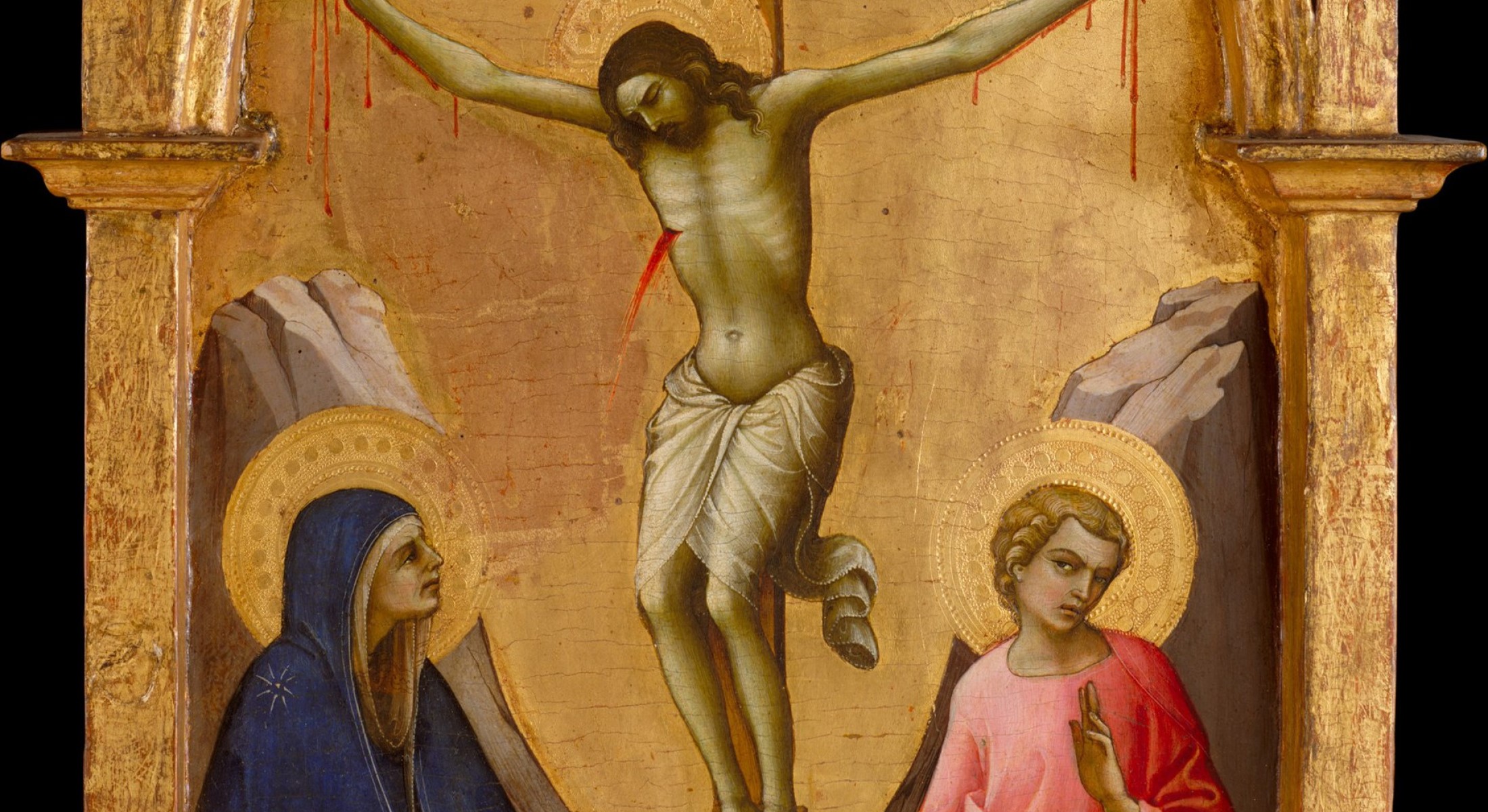
Whatever we think of the reality of this coincidence, the Gospel of John, read on Good Friday, does contain Mary at the heart of it. She is referred to as ‘the Mother of Jesus’, a title which relates her identity to Jesus, just as the beloved disciple is also described by his relationship to Jesus. They do not have names, because their relationship to Jesus is their true identity. We don’t need a coincidence of dates to see that the moment of the death of Christ and the moment of his coming into being as a human being are both bound up in the heart of Mary. In choosing to become the mother of the Word incarnate, she chose this day too, the day of his death. Did she know at first that in choosing the human life of Christ she was choosing his death too? Perhaps not. In Luke’s Gospel, the angel Gabriel speaks of a kingdom without end. It is only when meeting Simeon in the temple, that the cross starts to cast its shadow over Mary. ‘A sword shall pierce your soul, so that the secret thoughts of many may be revealed’ (Luke 2:37). Each moment of the life of her son, who is the Son, approaches this terrible moment. The death of Christ comes to her, and she comes to that death in her heart. This death is the nearest thing that the world could do to reverse the incarnation. The Son of God does not lose his humanity on the cross, but his soul is silenced and ejected from this world. Only the dead body remains, but it is still his body. An incarnation of death is left behind, but not for long.
The great hymn of the passion, the Stabat Mater, refers to the account of John. Mary stood at the cross, (stabat), and because of this, the Church discouraged local feasts and artistic depictions of Mary fainting. Mary stood at the cross because this was the culmination of her mission. Her grief was not diminished by this strength but intensified. She had taken into her heart the whole human life of Jesus, from conception to death, and so should we. We, as it were, borrow the heart of Mary when we consider the death of Jesus, and our contemplation has something of the power of her contemplating heart.
Some might ask, ‘Do we have to have Our Lady everywhere, even here?’ To which the obvious answer is that she was there, and not by chance. I would say it is especially here that we should have Our Lady, showing the unity of the life and death of Jesus the Christ. Why then is she not mentioned in the synoptic Gospels as being present, especially as the other Gospels speak of the presence of some other women? I don’t have a good answer to this, but I would make two points about what we are told by the other Gospels. Firstly, the three Gospels only tell us about the presence of the different women, after the death of Christ. They don’t deny that they were present at his death, but the emphasis is on what they proceed to do, caring for his dead body, and how they came to experience the Resurrection. Secondly, all three synoptic Gospels say that they were standing far off. John emphasises the nearness to Christ at his death, of Mary, daughter or wife of Clopas and Mary Magdalene. They stood by the cross of Jesus. None of the Gospels are concerned with spatial positions but with the meaning of their contemplation. It is only John who shows that Mary is at the heart of the contemplation of Christ in his death, and he is the only one who speaks of the other women being near to the cross. Mary is called the Mother of Jesus, and there is the disciple whom Jesus loved, but we should not miss that when Jesus speaks to them, she is just called the mother, and he is just called the disciple. That is what she is, the mother, and our mother, if we are to be a beloved disciple.
Readings: Isaiah 52:13-53:12 | Hebrews 4:14-16,5:7-9 | John 18:1-19:42
Image: detail from The Crucified Christ Between the Virgin and Saint John the Evangelist by Lorenzo Monaco via Wikimedia Commons (public domain)


Maria L
As we now know that the Suffering Servant and the Messiah are one in the same person, could Mary not have gleaned that from the scriptures, I wonder?
Euan Marley
I daresay, but it is interesting that the message of the angel, the Magnificat and the Benedictus do not speak of the suffering of the Messiah but of his triumph. This is the way that Luke tells the story, but in reading any story, we should let the author take us where he wishes, even when we know how the story ends.