

I Am the Door
Back in the early 2000s, a Japanese game show called ‘Brain Wall’ was all the rage. It required contestants to contort themselves into strange shapes in order to fit through a hole in a fast-moving Styrofoam wall. If the contestants failed, they were pushed backwards into a pool of deep water. It’s the image that came to mind when I read this Sunday’s Gospel: “I am the door of the sheep”, Jesus says. How exactly do we pass through our Lord and Saviour? Do we need to contort ourselves into being ‘Jesus-shaped’ so as to enter the pastures of eternal life?
The image that Jesus presents is in fact quite complex. This door of the sheepfold at first seems to be for passing through. Jesus will repeat the same point at the Last Supper, in the most famous of the great ‘I am’ sayings of John’s Gospel: “I am the way, and the truth, and the life. No one comes to the Father except through me.” (John 14:6) But the ‘door’ of this Gospel is not just a straightforward image of a gateway to heaven. It is a door both for entering and for leaving: the one who enters through Christ “will go in and go out and find pasture”. It is also a door opened by the gatekeeper, and through which the shepherd comes to his sheep. From this perspective, Jesus is now the shepherd, he who calls his own sheep by name. He will make this clear later in the passage: “I am the good shepherd”.
How do all these different images fit together? Is Jesus a door or a shepherd? Who is the gatekeeper? Should we aim to be inside or outside the sheepfold? We can perhaps sympathise with the Pharisees who “did not understand what he was saying to them”.
In the early 20th century, the American missionary William McElwee Miller was passing through a remote village in the east of Iran. He came across a small enclosure for sheep, built out of mud. It had an open doorway and walls covered with dried thorns. On enquiry, he learned that the thorns were supposed to make a noise when a would-be predator tried to gain entry, waking the shepherd who would rescue his sheep. But given the open doorway, Miller thought this arrangement strange: surely the thorns are superfluous. A wolf could simply go through the door. When he made this point, his companion told him: “O no, that is where the shepherd sleeps. The shepherd is the door.”
Who knows whether a practice in eastern Iran in the 20th century occurred across the whole of the ancient near east many centuries earlier. But the story beautifully brings together the constellation of images in our Gospel. Jesus identifies himself as the door and as the shepherd because he really is both. He is the shepherd who lays down his life for his sheep.
To pass through Jesus Christ, the way to the Father, requires becoming like Christ. Ultimately every image that Jesus uses points us to this one fundamental invitation: imitate me. “Love one another as I have loved you”, he says. This is the invitation that stands at the very heart of the Gospel. We must be like Christ and love totally and utterly, to the point of laying down our life.
The Japanese game show is not far off: we do need to become ‘Jesus-shaped’. This will require some contortion. Sin turns us in on ourselves. We need to stretch out and break free from the habits that restrict us. It is the stiff-limbed who are most likely to fall backwards into that pool of water.
But the life of Christ is also more capacious than we could possibly imagine. When we are conformed to Christ, we become more fully ourselves. This is what it means to have life, “and have it abundantly.” Jesus is the door of the sheepfold. We have life through him, with him, and in him.
Readings: Acts 2:14a, 36–41 | 1 Peter 2:20b-25 | John 10:1–10
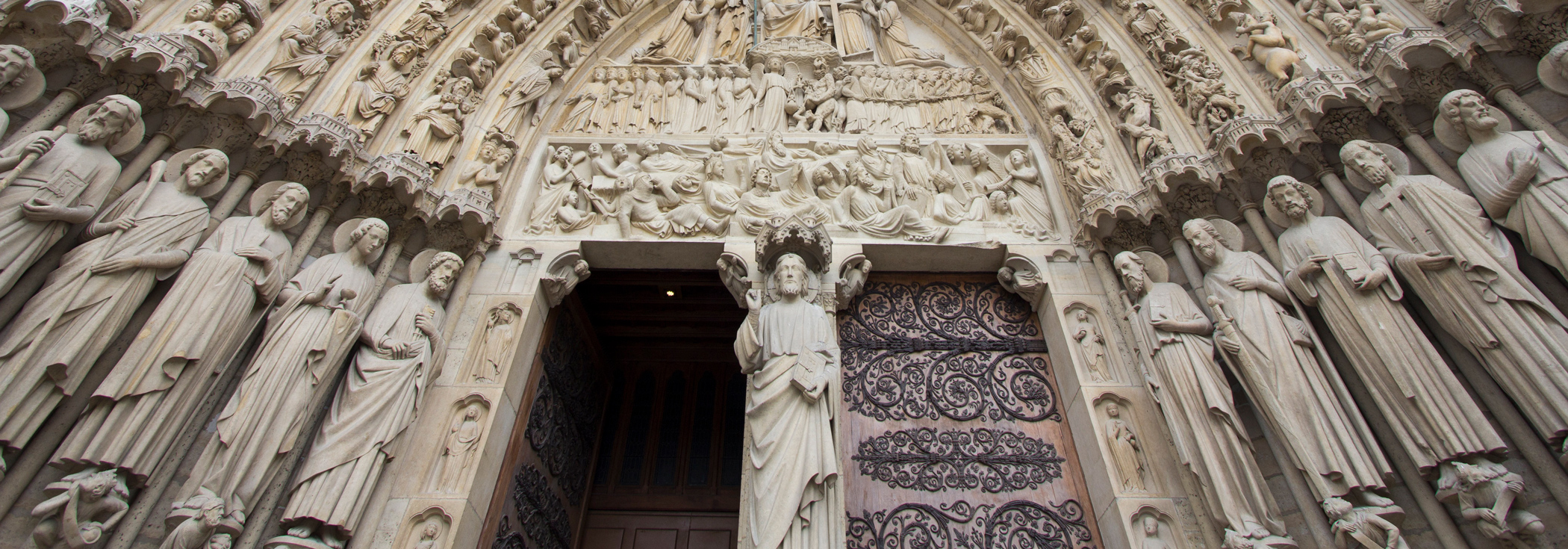
Image: The great west doors of Notre Dame de Paris, taken by Fr Lawrence Lew OP


Marion Jordaan
Thank you for an uplifting homily Fr John. Jesus being the door and the shepherd is interesting. I had never heard of the Japanese game show. Quite a challenge to become Jesus-shaped. Thank you
John Adams
John 10, verse 3 in particular brings to mind an Italian film adaptation of Tolstoy’s “Father Sergius”. “Il sole anche di notte”, “The Sun Also Shines At Night” (1990), set in 18th. century Italy.
Father Sergio is living as a hermit near shepherds. An arial shot has us see the top of the head of a shepherd appear in the middle at the bottom of the screen. As the head moves slowly up the screen, it is seen to be the top of a pyramid of sheep, who follow closely behind.