Out from the Centre
Seventh Sunday of Easter. Fr Simon Gaine considers Christ’s prayer to the Father.
In this Gospel we find Jesus on his way to the Father, a way by which the disciples are to follow. Jesus is going ahead of them to prepare a place for them in the Father’s house. They know where he is going – to the Father – and they know the way there, because Jesus tells them he is way. The Gospels place Jesus before us as the way to the Father, so that we can ponder this way, feel our way into this way, and follow along the way.
To get to know Jesus is to get to know the way to the Father. We find in Jesus someone entirely pointed towards the Father. He is totally trained on the Father from the depth of his being; his whole will is to do the Father’s will. The more we get to know Jesus, the more we find that he points us away from himself, and entirely into the depths of his Father’s love. We only have to give ourselves to Jesus, and we are transported into the very bosom of the Father.
We can see this in Jesus’ words to the Father – all that are mine are yours – everything that belongs to Jesus, including his disciples, belongs to the Father. We know it’s easy to live life by pointing to ourselves, by centring everything on ourselves,; and we know how enslaving all that can be. And so we know too how liberating it could be, if we were really prepared to walk the way of Jesus, to let ourselves fall away from the centre of ourselves, and allow everything to fall into a new pattern around the Son who takes us to the Father and makes us his.
But if getting to know Jesus moves us along this way, what can we learn to help us from today’s Gospel? The very first thing we encounter in today’s Gospel is Jesus praying to his Father, eyes raised to heaven. It’s quite remarkable. Because Jesus, like his Father, is God. But if Jesus is true God, why would he be praying? Surely, we might think, he should just be listening to our prayers, not making prayers of his own?
But the Father has sent his Son into the world to live the life of God’s eternal Son in a human life like ours. And when the life of the Son, whose loving gaze is trained from all eternity on the Father, is projected into human flesh and blood, it becomes prayer. And that should really be no surprise to us, because the human prayer of the Son, so open, so direct, so transparent, is so obviously the perfect expression of the eternal, divine love of the Son for the Father.
His prayer teaches us the way to love the Father with all our being; it teaches us how to take the centre away from ourselves and let the centre settle in the Father of us all. If we are to follow the way that Jesus is, we must follow his prayer – not just pray, but pray his way, share in his prayer to the Father. The result of this we can see in the Acts of the Apostles.
Our first reading tells us what took place directly after the ascent of Jesus to his Father, when he took his prayer into the Father’s house. The apostles go back to Jerusalem where they are in continuous prayer with the women and with Jesus’ mother and family. Luke, the author of Acts, uses here one of his favourite descriptions of the spiritual unity of believers: he says they devoted themselves to prayer with one accord. In other words, they were united in and by this prayer, which was moulding within them a single heart and mind for a single purpose.
United as they were by their knowing of the Father, this single loving gaze would lead them out in a single love for the very diverse world God had created and was already calling back to himself. So the prayer of this original group, a sharing in the prayer of Jesus himself, was answered by the gift of the Holy Spirit at Pentecost, which gave birth to the missionary Church with the gifts of many different languages.
And again, this should be no surprise to us, because if we look to the Jesus of the Gospels, we find that just as he is wholly given over to his Father, so his whole being is consumed by his mission – he is sent by the Father to draw us to himself, sent to bring us to know the Father. Because it is the Father’s will that we come to know the Father, so Jesus is consumed by love of us, just as he is consumed by love of the Father.
If Jesus were centred on himself, he could never have been consumed with love for the Father or for us. But instead, being a man of prayer, he was a man of mission too. As long as we are centred on ourselves, we are slaves, and we can neither truly know the Father nor love others truly; but if we allow Christ to take us towards the Father, he will send us to our neighbours, and then we will be free.
In his prayer Jesus told the Father that while he was no longer to be in the world, his disciples remained in the world. We are called to be on the way to the Father, but this means that we are also called to remain in the world as people who are sent here, as Christ was sent. If we feel that we are inadequate for this undertaking, then the truth is that we are inadequate, just like the first disciples. And yet God’s answer to our prayer is always the same: the gift of the Holy Spirit, who can equip us for every mission, as he makes us cry out to the Father. So let us pray for a new Pentecost in the Church, a new thirst for God, and for a new sending in love to our neighbours and to one another. Let us walk the way of Jesus Christ, and we shall see the Father.
Readings: Acts 1:12-14 | 1 Peter 4:13-16 | John 17:1-11
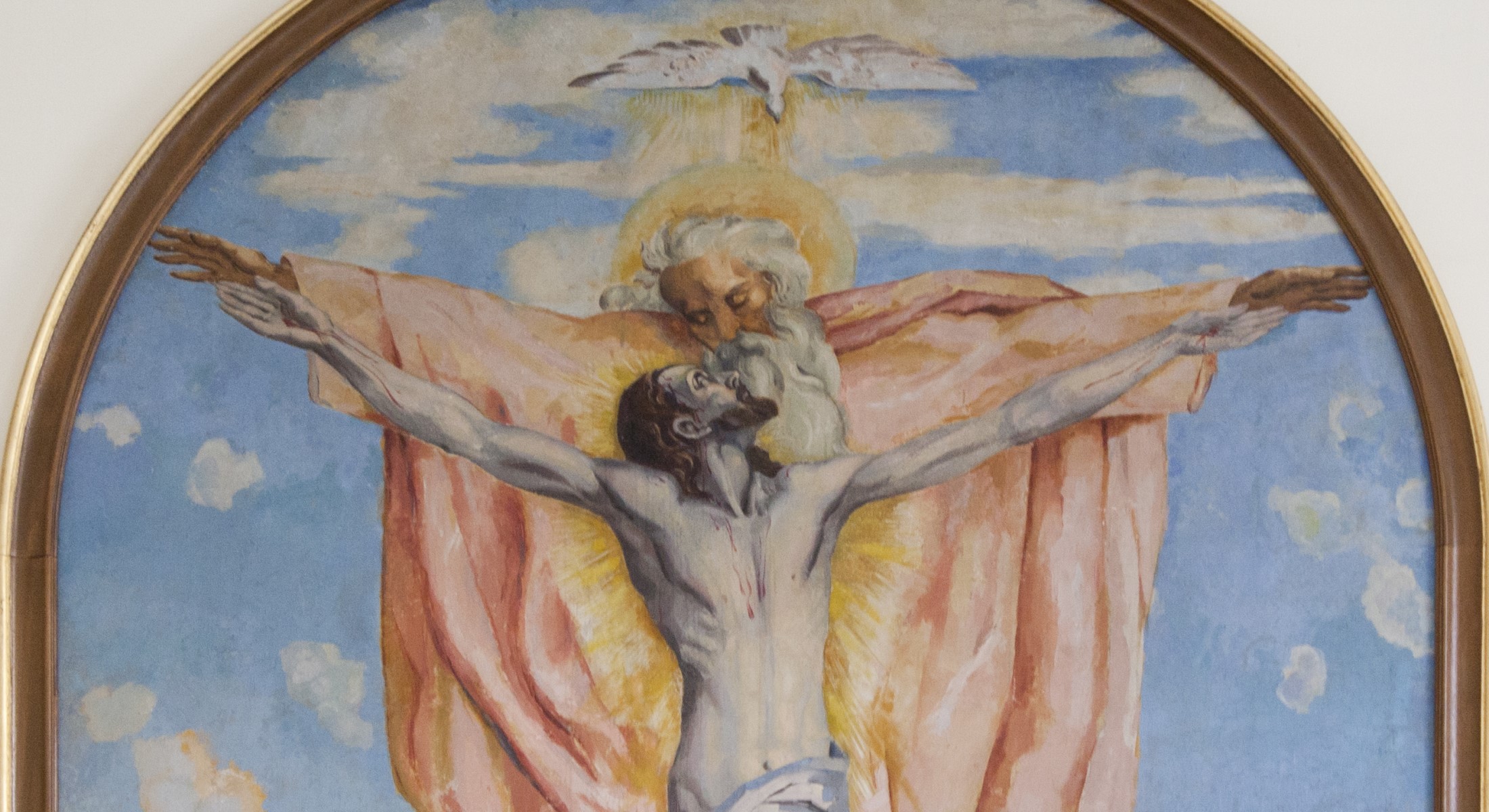
Image: detail from a painting of the Trinity in the refectory at the Priory of Santa Sabina, Rome, photographed by Fr Lawrence Lew OP