

No Distance
The Ascension. Fr Martin Ganeri shows how Christ’s ascent into heaven completes the incarnation.
‘And when he had said this, as they were looking on, he was lifted up, and a cloud took him out of their sight.’
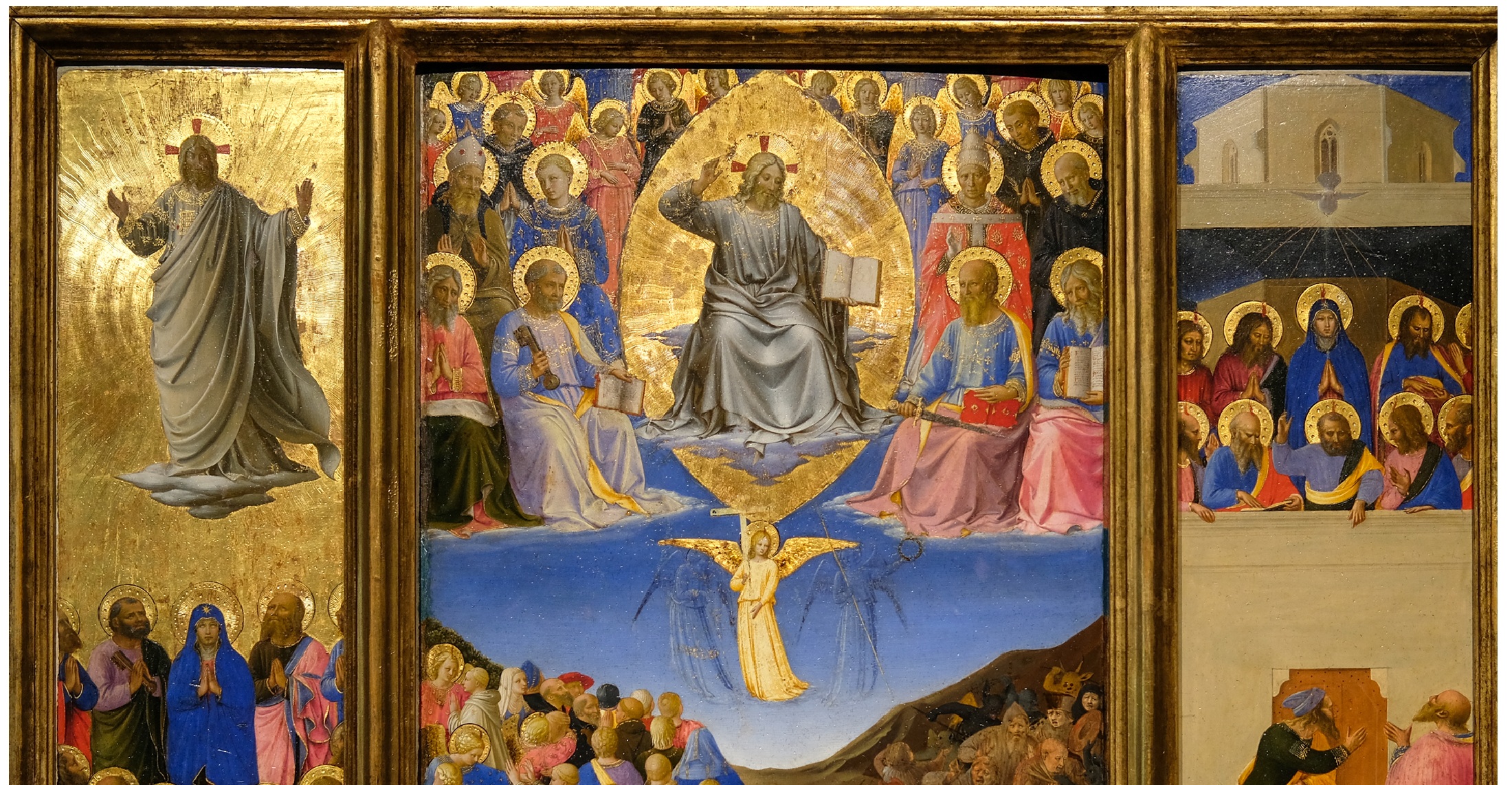
Today we celebrate the Ascension of Christ into heaven. If you look at pictures or icons of the Ascension you will see that they routinely depict Christ actually moving upwards towards heaven, with the disciples left on earth, as an attempt to portray the Ascension as recounted in the Acts of the Apostles.
However, we have to be careful here. The words and images we use are attempts to express in the spatial and temporal terms of our human world an event that that takes us beyond the limits of our space and time. When we try to capture this event with our own images, we can so easily end up missing out something that is important in what takes place. One problem with the Ascension is that the images we create make us think that this event creates a physical distance between Christ and the disciples, a distance between Christ in heaven and the disciples on earth.
In the Ascension what takes place is the full manifestation of Christ’s glorified humanity. His risen human body is now fully revealed as filled with the reality and power of his divinity. In the Ascension Christ does not move from one physical place to another. He does not move from being on earth with the disciples to leaving them and going to a far distant place above and beyond the earth. Rather, through the Ascension, Christ becomes more fully present to the disciples on earth and more fully active in what they do.
The Ascension is the completion of the work of the incarnation itself, the work, that is, of God assuming our humanity, so that he might fill it with the reality and power of his divinity. When the Son of God was born as a human being on earth, he also did not move from one place to another. Instead, the Son of God, always and everywhere present, took on the smallness of our human nature in one place and at one time, in the child at Bethlehem. This was the Christ with whom the disciples lived, with whom they ate and drank, the Christ who underwent the agony of the Passion, the Christ who, risen from the dead, had appeared to them in his risen body for forty days. Now in the Ascension he completes the work of his incarnation by revealing his glorified humanity completely and by making it available to them completely. He does not go anywhere. He does not cease to be present on earth. Although no longer physically visible to the few, his risen humanity is nonetheless fully present in the power of his divinity to the many.
There is also a second way in which we miss out on the wonder of the Ascension if we think of it creating a physical distance between us and Christ. For, if the ascended Christ is still present with us on earth, so he also makes us present with him in heaven. The ascended Christ is our great high priest in heaven, that is to say, in his divine realm and reality. Just as the high priests of the Old Law would enter the holy of holies in the Temple, with the blood of the sacrifice, to stand before God on behalf of the people, so Christ, our great high priest, has entered the sanctuary of heaven, not with the blood of animals, but with his humanity, which he sacrificed, pouring out his own blood. What he does with his humanity he does for all of us human beings, drawing us into heaven, as he intercedes for us, as he suffers with us and rejoices with us.
By placing our humanity in heaven, Christ gives us the hope that we may enjoy heaven also and, if we are in heaven in hope, so we are also there in love. Christ’s Ascension, as the promise of our own glorification, causes us to have love for the things of heaven, a love that is itself an expression of the love of God, the Spirit of Christ, who is given to us in Pentecost.
Readings: Acts 1:1-11 | Ephesians 1:17-23 | Matthew 28:16-20
Image: detail from the Corsini Triptych by Fra Angelico via Wikimedia Commons

Fr Steve Gemme
Wonderful homily. I have a question how does one access the liturgical index on your website? I do not see a link as it was listed before the upgrade. Many thanks
Father Stephen Gemme
chaplain
St Vincent Hospital
Worcester MA
Jerome Johnson O.P.
It’s here: https://english.op.org/news-and-events/ordo-liturgical-calendar/
Mary
Thank you very much, that was very interesting and helped me to see the Ascension in a new light!
Michael
Just beautiful Martin and so rich with meaning.
Another mystery I got the approach to wrong all my life – with my head in the clouds!
Thank you
Catherine
Thank you so much for this, Father Martin. I’ve struggled with this wondering how it can tell me. I felt sure there was much more but couldn’t think quite what. This is so insightful and encouraging.