

Cast Out Fear
Twelfth Sunday of the Year. Fr Gregory Pearson invites us to open our eyes to the reality of God’s love.
Human beings like to know where we stand, to have a sense of our value and status. That’s not surprising; it’s part of how human societies function, and it’s an instance of the way humans approach the world, seeking to understand it and not simply to experience it. It reflects the fact that we recognise that there is meaning and value in creation.
But the problem is that we’re not very good at doing the measuring. If we want to measure speed or weight or distance, we have units in which and instruments with which to do so. But when it comes to ourselves and our place in the world, things are not so clear.
In today’s Gospel, Jesus uses monetary value as a starting point for a comparison—sparrows are two a penny, and God knows what we might think of as insignificant information about such seemingly low-value creatures—and, since we are worth much more than sparrows, we don’t need to worry about what our value might be in the sight of God. This, of course, is manifested for us supremely in the person of Christ himself—in that perfect love for humanity which he shows in the mysteries of his incarnation, death, and resurrection.
Our value, then, in God’s sight does not originate in our own achievements or in passing some kind of test. As St Paul tells the Romans, our relationship with God – and its distortion through sin – is not determined fundamentally in terms of obedience to the Law, since human beings – and human sin – existed before the Law was given. If we see God’s teaching as merely an external imposition—a tool with which to determine our value in his eyes—we have already failed to understand the wisdom of God, because we have failed to recognise that he does not give us commands in order to establish a framework within which to measure us (since he knows us already better than the sparrows Our Lord speaks of in the Gospel) but to teach us our true worth—to teach us that we are called to be holy as the Lord our God is holy, because we are made for friendship with him.
And yet the Gospel is not simply a message of reassurance. Yes, we are valuable in God’s eyes – he loves us, indeed – but we are capable of failing to recognise the true worth that is ours in Christ. We are capable of rejecting it by acting, as the Lord says, out of fear – fear that is misplaced because it stems from a failure to apprehend the depth of God’s love for us.
The prophet Jeremiah is presented to us in our first reading as the opposite of that reaction of fear. He is in the midst of a terrifying situation. He is being persecuted for telling people things they don’t want to hear—his prophecy of the impending sack of Jerusalem and exile of its population as a consequence of the people’s unfaithfulness to the Lord—and he, by contrast, is a model of faithfulness both in his perseverance in what he recognises as his prophetic duty and in the trust in God which he expresses in the midst of these trials.
Our true value is not in question: God’s mercy, his faithfulness to us, is without end. When we really apprehend that—when we learn to see ourselves as God sees us—then, like the prophet Jeremiah, we will recognise that there is really no question of whether to choose faithfulness to him in our turn, despite the suffering it might bring for a time, because we no longer see God’s law, his teaching, as something imposed from outside, a means for determining our value to him. Instead, we begin to recognise it for what it is: the wisdom of our loving God, calling us into his friendship.
Readings: Jeremiah 20:10-13 | Romans 5:12-15 | Matthew 10:26-33
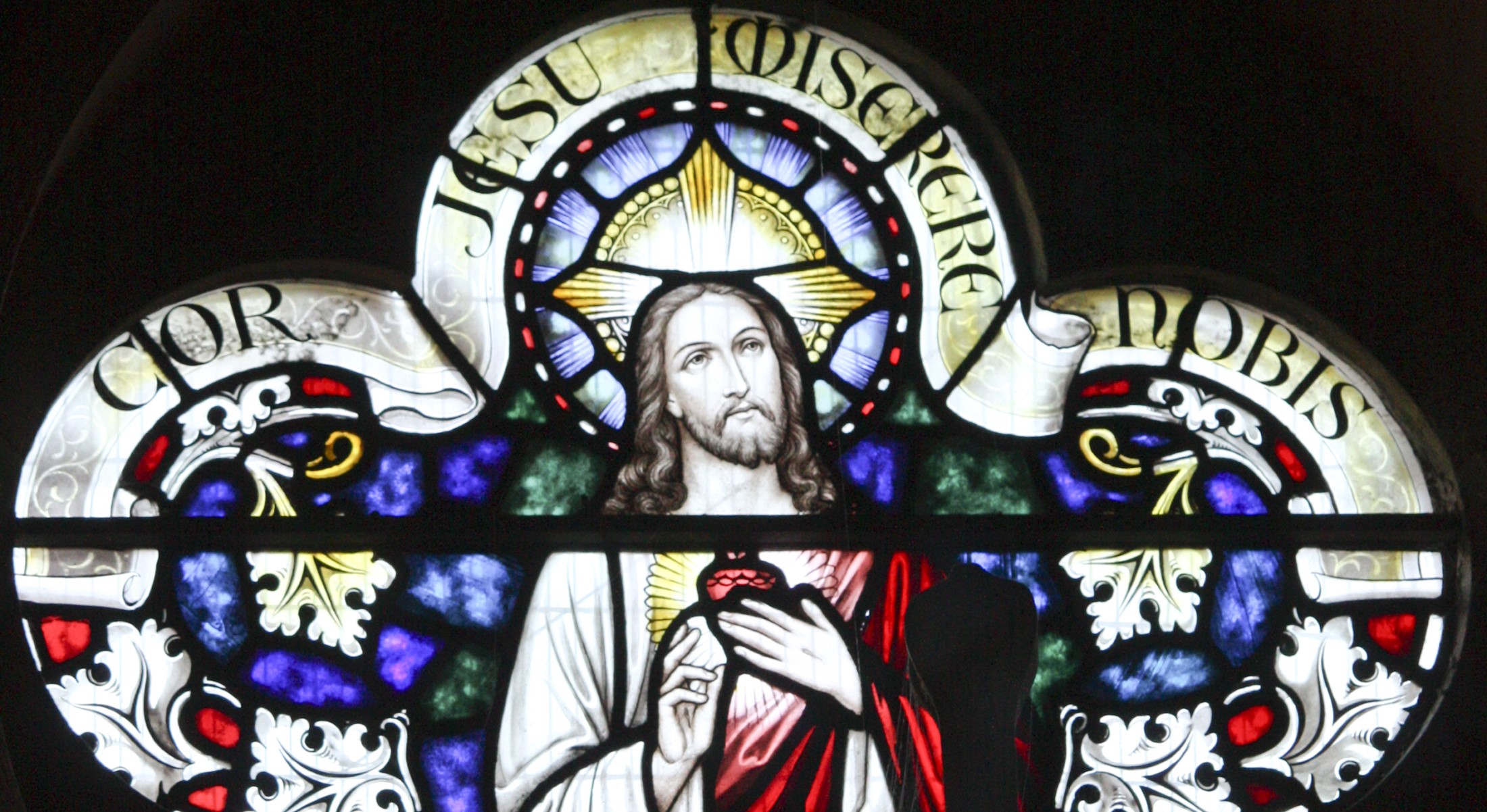
Image: detail from a stained glass window in the Catholic church of The Sacred Heart and Saint Aldhelm in Sherborne, photographed by Fr Lawrence Lew OP

Andrew Foster
Beautifully put, Fr Gregory. The origin of the “imposter syndrome” that even the most gifted suffer from is surely not to have discovered the implicit liberation of the new law of Christ.