The Stone of the Tomb and the Flesh of the Risen Christ
Let us not memorialise the tomb, but enter it, so that we may rise with Christ
The following homily was preached to the student brothers during Compline. You can listen here or read below:
Reading: Luke 11:47-54
The building of graves and tombs is a fundamental sign of culture. It’s a sign of intelligent culture. You can always tell the sophistication of a culture by how they treat their dead. So, I don’t think it’s the actual building of tombs that Christ is criticising here. But it’s rather this act of memorialising the prophets without letting their words lead to any kind of conversion.
In a sense, the people that Jesus is criticising are those who posture saying, “Look, we follow the prophets,” but can’t recognise the One about whom the prophets spoke, and in fact, go on to kill that person: to kill Christ and commit the very deed that their forefathers did. That’s what Christ is talking: about simply turning the words of the prophets into a memory.
Now in a certain way all of the prophets are found to be in Christ. Christ is the Son sent by the Father at the last, and in Christ, the prophets and their words see their fulfilment and they also see their vindication. Christ is the central point of vindication for all who suffer for righteousness. After Christ, all people who suffer for righteousness, the martyrs we celebrate, look back to Christ and announce the victory of that vindication.
But in a certain way, we are also in the people who killed Christ. When we refuse to be converted, we are in the hypocrites who simply memorialise the death of one sent by God. And it’s worth us reflecting upon this because Christ came to remove this cycle of the rejection of the word of God. By sending His Holy Spirit, He has given us hope that we can move from hearts of stone to hearts of flesh.
But, when we fail to convert, we become stuck memorialising the stone of the tomb and not the flesh of the One who entered into the tomb. In what ways do we merely memorialise the tomb of Christ? Perhaps we use the tomb of Christ, the stone of the tomb of Christ, as an excuse to wait behind and criticise others without ever looking into ourselves. Perhaps we pave a path of good intentions around the tomb and never make an effort to remove habitual sin with the help of grace. Perhaps we memorialise the tomb in such a way that we think we only deal in grand gestures and neglect the holiness that is to be found in the pots and the pans.
But we’re called to something extremely existential and urgent. We’re called to give our whole lives. We’re called to pick up our cross and follow Christ into the tomb.
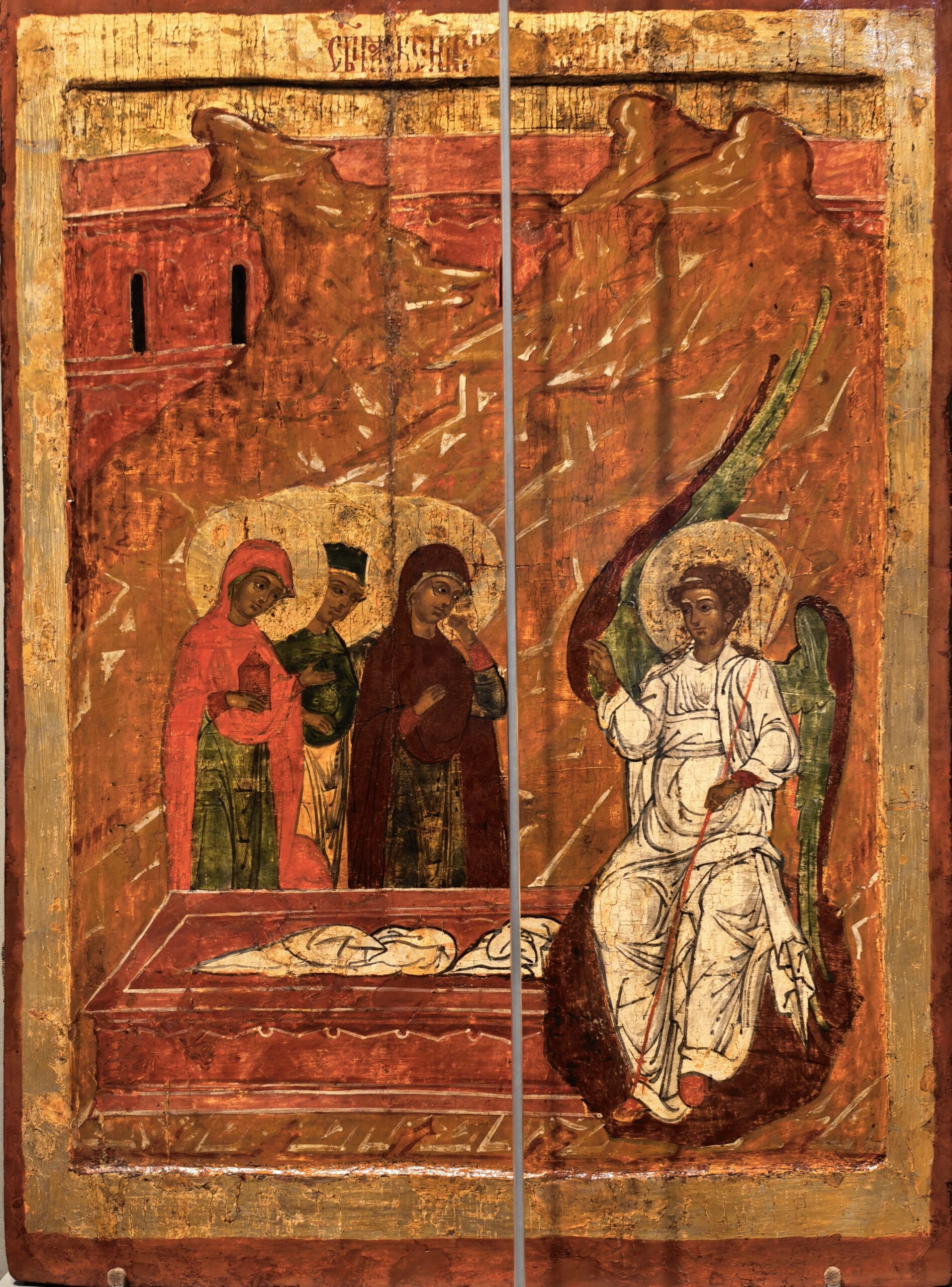
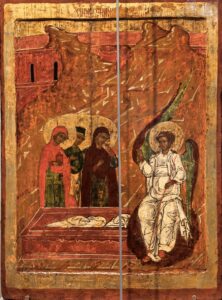
But here is the twist. When we enter into the tomb, we don’t see Christ. We see an angel telling us, “Christ has risen and has gone before you to Galilee.” Will we shed the clothes of death, of hypocrisy, of sin, and follow Christ towards Galilee?
“When I hear, may I run and lay hold on thee. Hide not thy face from me. Let me die, lest I die. If only I may see thy face.” Amen.
Image: Icon of the Myrrh-Bearing Women at the Tomb, first half of the 17th century (Arkhangelsk Region): Russian Icon Painting, Hall 143, State Hermitage Museum, Palace Embankment, 34, Central District, St. Petersburg.
Courtesy of Wikimedia Commons.