
Faithful Stewards
Twenty-First Sunday of the Year. Fr Joseph Bailham invites us to consider how we use the keys that have been given to us.
21st Sunday in Ordinary Time – Year A
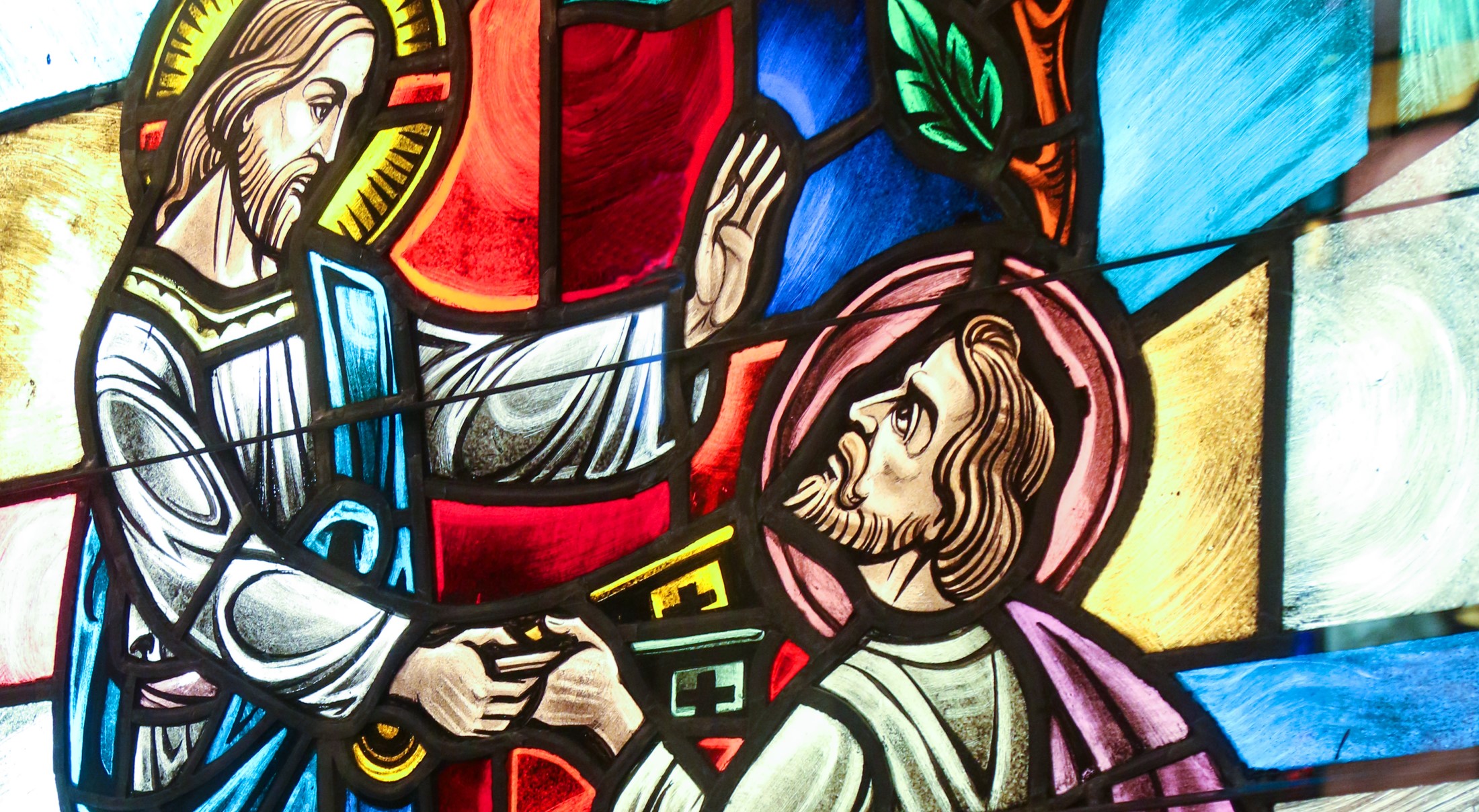
In the Gospel, St Peter is named the rock on which Christ will build His Church. That declaration comes only after St Peter’s own declaration of who Jesus is: ‘You are the Christ, the Son of the living God.’ Peter isn’t ranking Jesus alongside Jeremiah or Elijah, one more voice in a long line of prophets. He’s saying something else entirely — that the man standing in front of him is the source of all life itself, God made visible in flesh.
Our Lord’s response tells us where that confession came from: ‘flesh and blood has not revealed this to you, but my Father who is in heaven.’ St Peter didn’t reason his way to this realisation. It was given to him. What follows — the naming of St Peter as the rock, the promise that the gates of hell will not prevail — therefore isn’t St Peter’s achievement either. The Church begins with God’s initiative, the same way Peter’s confession did, and not by human fabrication.
That’s worth sitting with before we go anywhere near the question of authority, because it changes what authority means here. Our first reading gives us the pattern for what Our Lord does with St Peter. God removes one steward, Shebna, from his post as master of the palace, and in his place raises up Eliakim, on whose shoulder he places ‘the key of the House of David.’ It’s worth knowing what Shebna had done with his position: Isaiah elsewhere tells us he had used his office to carve himself a fine tomb in the rock, to make himself a name that would outlast him. He held the key of the house and used it to build a house for himself.
Eliakim is given the same key for the opposite purpose. Isaiah calls him ‘a father to the inhabitants of Jerusalem’ — his authority is described entirely in terms of what it opens up for other people, not what it secures for him. He is called a peg, something useful because it is fixed to someone else’s house, not because it’s noteworthy in itself.
This is the key that St Peter is given in the Gospel — not power to make himself great, but a trust bestowed upon him, a responsibility, a means to serve others. Peter as a rock is only ever a foundation for something else — it is not the Church of Peter but the Church of Christ.
In a sense each of us has been given a key. We may not hold the keys of the kingdom of heaven, but we hold keys of a smaller kind which do indeed bear on the kingdom of heaven. We hold the key to whether someone in our lives is forgiven or shunned. We hold the key to whether someone we might have some authority over — a colleague, a child, a friend — is treated as someone made in God’s image or merely as someone useful to our own desires.
The first reading and the Gospel this weekend draw our minds to the stewardship of God’s gifts, and how we are using them. Shebna had a key and built himself a tomb. Eliakim had the same key and became a father to his people. Peter is given the keys of the kingdom, and what’s built on him is never his own name, but Christ’s Church. The pattern is the same each time: whatever has been entrusted to us, however small, can be used in service of others, or it can become a monument to ourselves.
Christ has given us many gifts, some personal to us, others more objective like the sacraments. All are given to us for the greater glory of God. Of course, we might recall St Irenaeus who said that ‘The glory of God is a human being fully alive.’ These gifts are given for our flourishing as human beings, but also to enable others. We are strengthened, we are given keys, to enable others to discover the freedom that can only be found in Christ, the Son of the living God, and through his body, the Church.
We are entrusted with much. We are made stewards. How are we using what has been given to us?
Readings: Isaiah 22:19-23 | Romans 11:33-36 | Matthew 16:13-20
Image: detail from a stained glass window in Charles Town, West Virginia, photographed by Fr Lawrence Lew OP


John Adams
The quote by saint Irenaeus put me in mind of a cartoon seen in a Catholic newspaper many years ago. A man, fast asleep in an armchair, approached by his wife with a cup of tea & the caption – “The Glory of God, … a man [sic] fully alive!”