
The Awkward Bits
Twenty-Third Sunday of the Year. Fr Benjamin Earl preaches on the sometimes difficult duties imposed on us by Christian charity.
Over the last few months, ‘excommunication’ has been in the news in the Church. This was perhaps a surprise to some people, who thought excommunication was something that belonged more to the Middle Ages than the twenty-first century. Surely all we Christians need is love, not processes and penalties? Isn’t love the ‘fulfilling of the law’ (Romans 13:10), as St Paul says today?
And yet, here is Jesus himself in today’s gospel saying that ‘if our brother sins against you’… and if you follow all the steps, first talking to him one-to-one, then calling on witnesses, then taking it to the church, and still he does not change his ways, then ‘let him be to you as a Gentile and a tax collector’ (Matthew 18:15–17) — a tax collector for the Romans, of course. Let him be to you, that is, as an outsider, someone who is beyond the pale, someone whom ‘decent’ people would want to avoid. Or, using language which the Church adopted in the following centuries, but which basically comes down to the same thing: ‘let him be anathema’, or ‘let him be excommunicated’.
Nor is this gospel process leading to excommunication an optional extra. It is true that elsewhere, in situations where outsiders might do evil to us, Christ invites us to turn the other cheek or go the extra mile (cf. Mt 5:38–41). Retaliation and retribution should not be part of the Christian vocabulary; but that doesn’t mean that we shouldn’t call out sin and evil for what it really is, nor that there are no consequences for unrepented evil. Christ tells us that we must correct our brothers and sisters who sin against us… fully aware that it can be awkward, delicate, and embarrassing.
The prophet Ezekiel in today’s first reading is explicit: ‘If you do not speak to warn the wicked to turn from his way…’ yes, it may not go well for him, ‘…but his blood I will require at your hand.’ If we don’t correct sinners, there are serious consequences for us. Excommunication is a gospel imperative; it is, sadly, sometimes necessary.
Now, before we get carried away and start excommunicating each other, it is important to note how Jesus himself treats those who are ‘beyond the pale’, the Gentile and the tax collector.
Just limiting ourselves to St Matthew’s Gospel, we have Jesus healing a Roman centurion’s (presumably gentile) paralysed servant and praises the faith of the centurion himself (8:5–13). Similarly, he heals the daughter of the Canaanite woman and declares: ‘O woman, great is your faith’ (15:21–28).
Neither should we forget that Matthew himself is a tax collector called by Jesus to be an apostle (cf. 9:9–13; 10:1–4), and that Jesus would sit down with tax collectors and other sinners, presumably including Matthew.
How does Jesus treat gentiles and tax collectors? He calls them to conversion; he heals them; he spends time with them; he sends them out to preach the good news. In short, he loves them, and he calls them to love him.
The Church, of course, should do no less; when the Church denounces evil, it is not because we hate the evil-doers and want them to perish… on the contrary, we love the evil-doers, and it is partly out of love for them that we wish them to desist from the evil they are doing and follow Christ. And when the Church, in extreme cases, excommunicates one of her own members, it is not because she hates him or her, but rather a measure taken out of love for our errant brothers and sisters. We must love them; we must pray for them; we must pray with them; if their faith is great like that of the Centurion or the Canaanite woman, we must not be afraid to praise it; and if, having repented, they can, like Matthew, be useful in the apostolic ministry of the Church, we must rejoice.
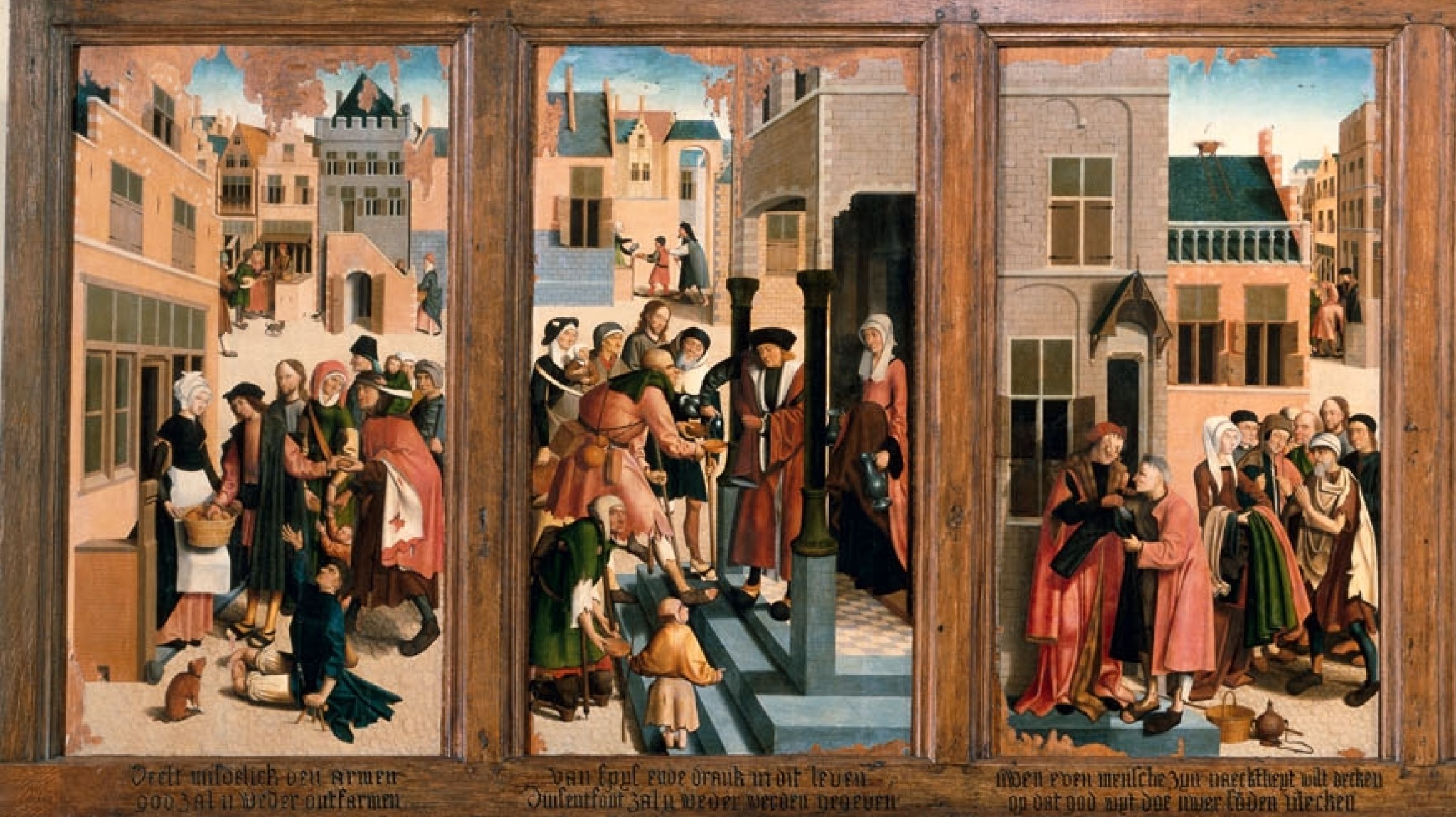
This love is expressed in the seven Spiritual Works of Mercy. Yes, ‘forgive offences’ and ‘bear wrongs patiently’; but we must also ‘counsel the doubtful’ out of love for them, not to control them; ‘instruct the ignorant’ out of love for them, not to show our supposed intellectual superiority; and ‘admonish the sinner’ out of love for them, not because we get a kick out of giving somebody a piece of our mind. And when, God willing, there is repentance, we must ‘comfort the sorrowful’, welcoming them with open arms, all out of love for them, without forgetting that love for all requires us constantly to ‘pray for the living and the dead’.
Ultimately love is indeed the fulfilling of the law… and that includes the awkward bits.
Readings: Ezekiel 33:7-9 | Romans 13:8-10 | Matthew 18:15-20
Image: detail from The Seven Works of Mercy by the Master of Alkmar via Wikimedia Commons (public domain)