The Rising of the Body
Easter Sunday. Fr Aidan Nichols is confident that the Church will share in the Resurrection of her Head.
After the Revolutionary period which in Continental Europe swept away most of the institutional markers of Catholic Christendom, the German poet Heinrich Heine asked: ‘Don’t you hear the bell ringing? Get down onto your knees. They are carrying the sacrament to a dying God’. Fifty years later, the apostate priest and biblical scholar Ernest Renan spoke of how it would soon be necessary to take the faith and ‘carefully roll it up in the purple shroud where dead gods sleep…’. ‘We have put out the lights of heaven’, said an atheist politician after the successful campaign to abolish the schools of the Religious Orders in early twentieth century France, ‘and they will never be lit again’.
Sometimes, when we look at the condition of culture, of the media, of science, of entertainment, of opinion, we may be tempted to agree. If so, we are forgetting the words of Newman at the end of his Essay on the Development of Christian Doctrine. ‘It is true there have been seasons when, from the operation of external or internal causes, the Church has been thrown into what was almost a state of deliquium [i. e. total eclipse]: but her wonderful revival, while the world was triumphing over her, is a further evidence of the absence of corruption in the system of doctrine and worship into which she has developed. After violent exertion men are exhausted and fall asleep; they awake the same as before, refreshed by the temporary cessation of their activity, and such has been the slumber and such the restoration of the Church. She pauses in her course, and almost suspends her functions; she rises again, and she is herself once more; all things are in their place and ready for action.’
The point Newman is making is that the Body of Christ, his Church-Body, can never get away from the Easter story. Like Head, like Body. When public opinion turned against our Lord, who was in turn rejected by the crowd, condemned by the authorities and submitted to an ignominious death, he was not only written off, treated indignantly as wrongheaded or cynically as an irrelevance or anxiously as a threat to the status quo. More than that, he was treated as obscene, as an abomination. That was how the Law regarded a crucified man: ‘Cursed be everyone who hangs upon the tree’.
There was, however, a surprise in store. Jesus the Son may appear to be cursed but in reality he is more than ever the Beloved of the Father. His obedience to the mission the Father had given him – to demonstrate God’s loving mercy in risking his all for sinners – this obedience reaches its climax, its ultimate perfection, when he is raised up on the Cross.
And so now, at Easter, in the Resurrection the Father glorifies the Son who as man has so wonderfully glorified him. The Father communicates to the Son made man, precisely as the Crucified, the Glory that is the Holy Spirit, whom we call in the Creed, the ‘Lord, the giver of life’. He seemed dead and gone but he was far more alive than ever before. ‘Christ being raised from the dead will never die again; death no longer has dominion over him.’ And we mustn’t forget how that passage continues: ‘So you also must consider yourselves dead to sin and alive to God in Christ Jesus’.
We mustn’t forget it because it is the key. We have come to the end of an era in the Catholic Church in our country when it was easy to be a Catholic either because the institution was so successful, as in the 1950s, or because reforming it was fun, as in the 60s and 70s, or because Cardinal Basil Hume made it so popular, in the 80s and 90s. We have left an era when it was dead easy and have entered on a new time, when our motto will have to be ‘Dead to Sin and Alive to God’. Continuing conversion, death to sin, real spirituality like the saints had, life to God. That is the only way the Church-Body can follow to the Resurrection her glorious Head.
Readings: Acts 10:34,37-43 | Colossians 3:1-4 | John 20:1-9
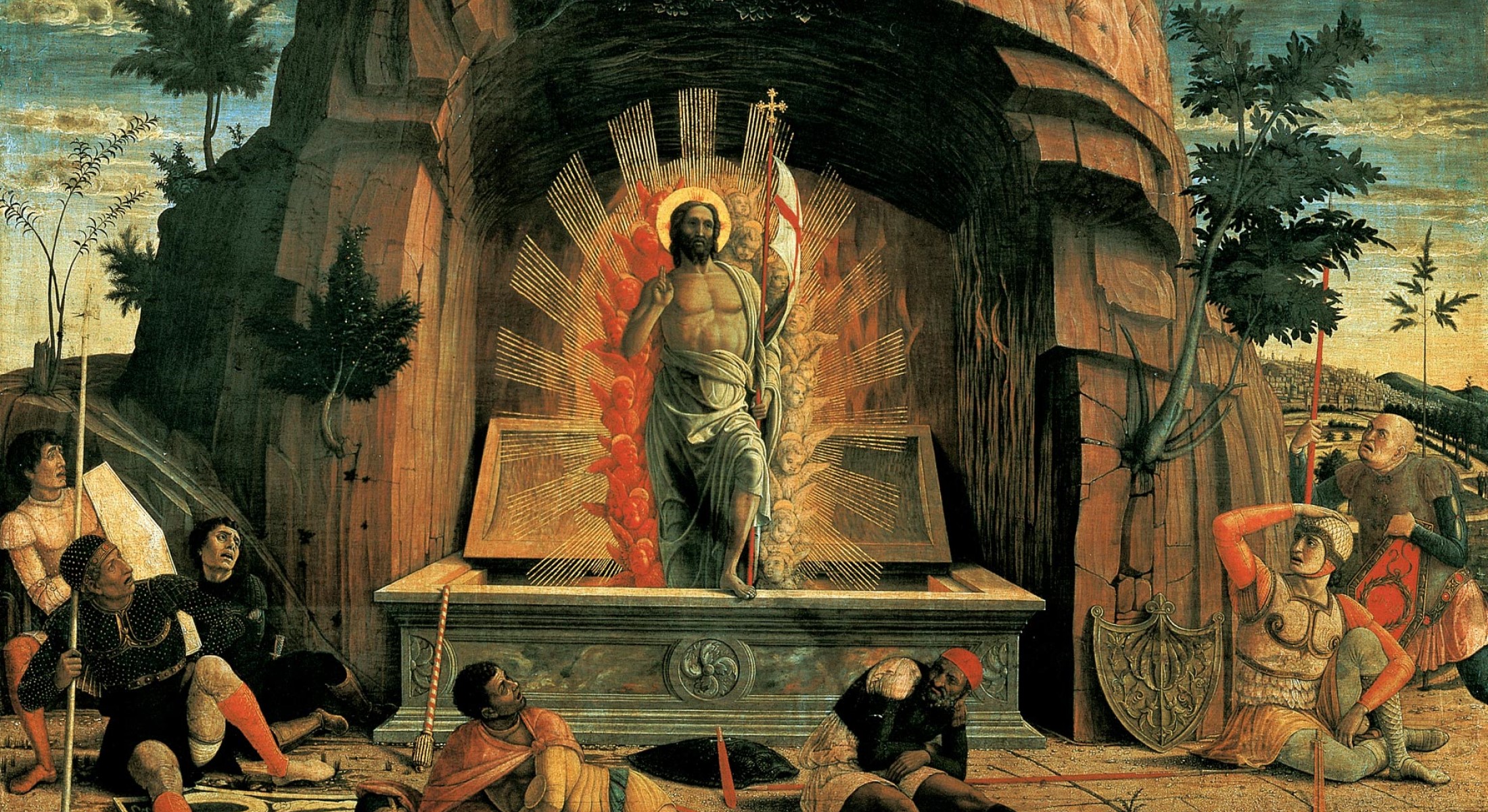
Image: detail from The Resurrection by Andrea Mantegna via Wikimedia Commons