More Deeply Alive
Twenty-Sixth Sunday of the Year. Fr Timothy Radcliffe offers a deeply Catholic vision of the moral life.
At first sight it may seem that the issue in today’s gospel is whether one does God’s will or one’s own. We pray in the Lord’s prayer ‘Thy will be done.’ Jesus is the model of perfect obedience. In the Garden of Gethsemane, Jesus accepted the will of his Father: ‘Not as I will but as you will’ (Matthew 26.39).
If this all that were to be said, our faith would seem to be oppressive and even infantile. But God wills our human flourishing and thus our freedom. St Paul tells us that we are called to share the freedom of the children of God. ‘For freedom, he has set us free’ (Galatians 5.1). St Thomas Aquinas claimed that our desires are always, in some sense, for the good. To sin is not so much to desire what is wrong as to desire what is too small at the expense of a deeper good, God’s friendship and joy. If I were to murder one of my brethren because they made an irritating noise, I might desire a tiny good – peace and quiet – at the expense of the deeper good, the love of my brother and of God. The Ten Commandments put me in touch with our most fundamental desire, to share God’s friendship.
When I gave up smoking, I adopted a Thomistic approach. I wrote down all the reasons why I really did not wish to smoke – because it was bad for my health, because I could not afford it and it made my clothes smell and so on. Every time I wanted a cigarette, I studied this list until I was freed for a while from the tug of a passing urge.
So the son who eventually does the will of his father is not just being submissive. He discovers a new depth to what he wants. His greatest happiness is not to lie in bed, attractive as that is. It is to share the life and work of his father. The lives of the tax collectors and prostitutes are transformed, perhaps painfully, as they recognise in Jesus the love for which they had always longed without knowing it.
Romanos the Melodist, a sixth century composer of hymns, claimed that the sinful woman who repented when she met Jesus had discovered what she really sought in her erotic life. Simon Tugwell OP wrote that ‘the unchaste love was an abortive experiment in loving; it is essentially the same experiment that now succeeds in Christ’. Are we prepared to open ourselves to the deep joy and freedom to which God calls us, even though it may painfully shake up our lives? Or do we shut our ears and remain stuck in mediocrity?
One might object that it seems unfair that the initial obedience of the son who is condemned seems to count for nothing. Doesn’t his earlier goodness merit some reward, even if he goes wrong at the end?
The point is that the life of virtue is not about committing more good deeds than sins, so that they can be totted up and balanced against each other at the end. A virtuous life makes one ever more capable of spontaneously doing what is right. One becomes more deeply alive with the grace of God. What matters who one is becoming rather than just what one did. On the beach, the Risen Lord asks Peter, ‘Do you love me?’ Is he prepared to embrace the love now that he denied in the house of the high priest? Is he on the way?
Of course we go on committing sins, succumbing to small desires that harm us and others. But slowly, even imperceptibly, with God’s grace we hope to grow in our desire to work in the Father’s vineyard because this is our true delight. Maybe we shall still yearn for the warm beds we have left behind, and even steps backwards sometimes, but may the grace of God bring us to rebirth as men and women who share the freedom of Jesus.
Readings: Ezekiel 18:25-28 | Philippians 2:1-11 | Matthew 21:28-32
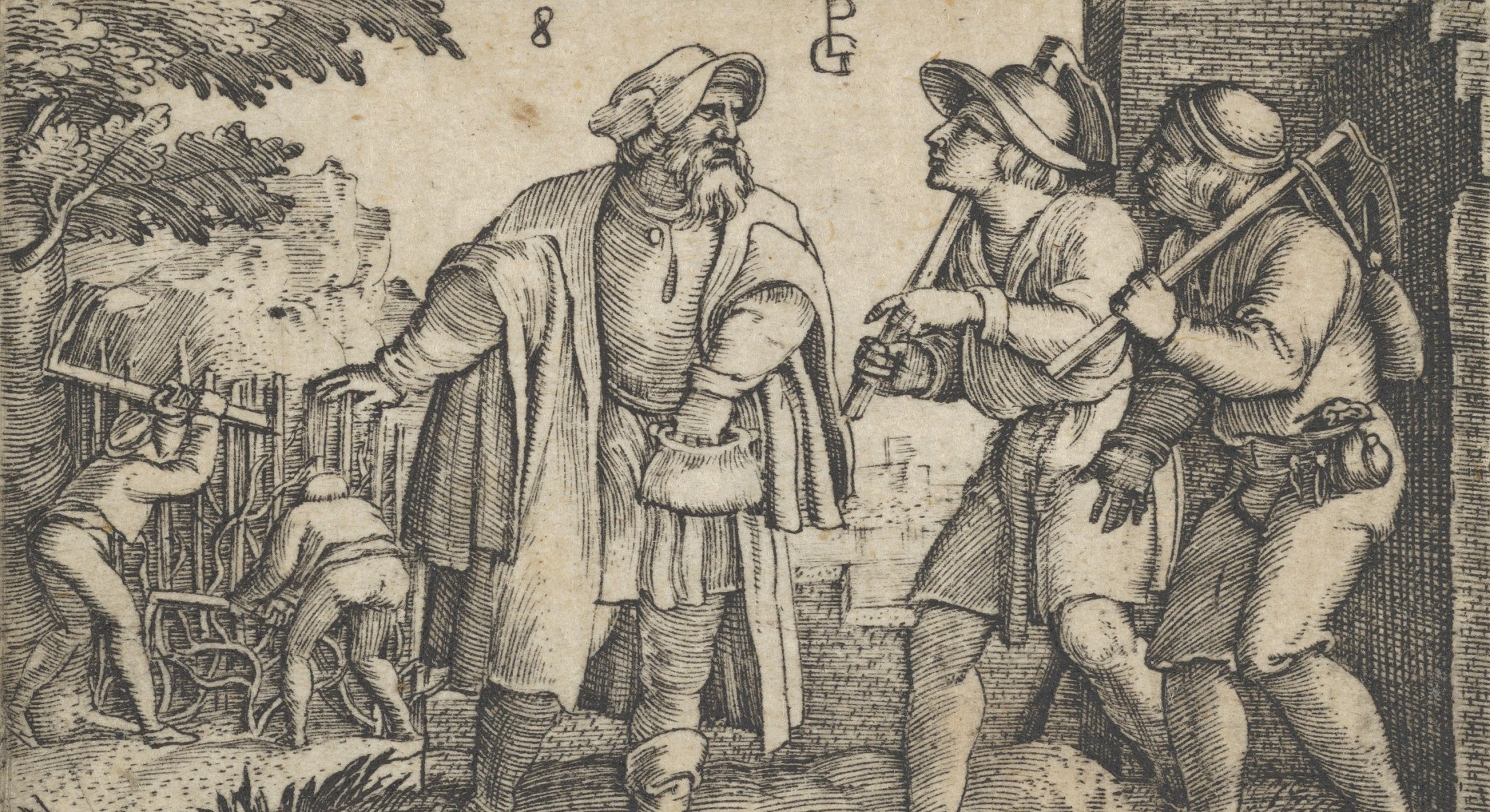
Image: ‘The Parable of the Father and His Two Sons in the Vineyard, from The Story of Christ’ by Georg Pencz (public domain)