
God at the Centre
Twenty-Seventh Sunday of the Year. Fr Peter Hunter warns us against thinking that we are in the driving seat.
If you are a chief priest or an elder, I expect you feel pretty central. I expect you feel pretty important. The chief priests were priests of a religion established by God, and their role in that religion must have made them feel like they were accepted, even favoured by God.
It’s true, the prophets often pointed to the flaws of the leaders of Israel, and even told them, from God himself, that they were not in favour. So the prophet Hosea tells them, speaking the words of God, ‘What I want is mercy, not sacrifice.’
Sacrifice was a demand of the Law of God, but the people had strayed far from what it should mean. Their acts of religion were worthless because they were not done in a context of love and mercy.
Our first reading is like that, of course. The vineyard of the Lor is the house of Israel, but, in spite of being tended by God and given every possible advantage, the vineyard has yielded only sour grapes. The people of Israel have been loved and protected by God, but they have not borne the fruits of the vineyard.
At first sight, I think our parable from Matthew’s Gospel may have struck the chief priests and elders a bit like that, as a prophetic call to be a faithful vineyard of the Lord. It’s important to see that something much more radical is happening, though.
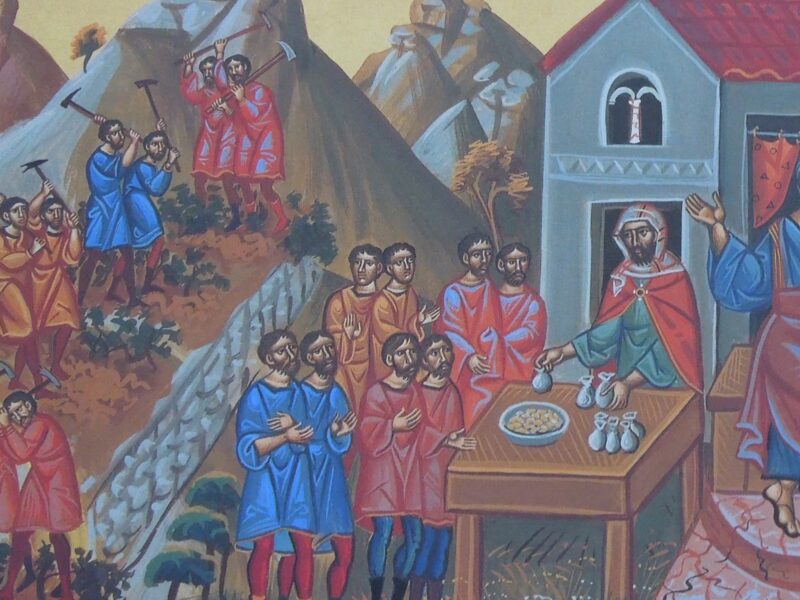
For a start, the images in the prophets of the vineyard make Israel that vineyard. The image is of God planting a vineyard and fencing it round, and so on, and then not finding the proper fruit. But in the parable in today’s Gospel, the chief priests and elders are not part of the vineyard. They are only its tenants. They are not cast as the central figures they must have seen themselves as, but in a role which is more peripheral and subservient. The complaint isn’t that they, as vines, have produced substandard fruit, but that they, as tenants, haven’t handed over the fruit to the landowner.
And this is not coincidental. It’s vital to Jesus’ parables that the tenants want to seize control. They won’t accept their place of service. They want to be in charge, and have the vineyard for themselves. They try to take control by violence.
Jesus is, of course, prophesying his own death, which he will suffer at the hands of the Romans, demanded by a crowd egged on by these same chief priests and elders. They would, I’m sure, have seen their acts as a righteous defence of God’s religion. Jesus makes clear it is a grubby power grab.
Where does that leave us? We’re not, in any straightforward way, making the error that these chief priests and elders are. But I wonder if sometimes we too have to deal with a shock that we’re not quite as important as we think.
One of my young family members talks about people having ‘Main Character Syndrome’. She means they think they are more important than they really are. They imagine that they’re the main character in the story, the one around whom everyone else’s lives turn. But most of the time, most of us have a relatively minor part in any particular story.
It seems to me that even when we think of our own lives, if we are Christians, the one at the centre of our lives is not ourselves, but God. I don’t mean we recognise that, most of the time. We enjoy thinking we are in the driving seat. Or maybe we dread that thought.
But whether we like the idea or dread it, it’s actually wrong. Even in our own lives, we are tenants. We have everything we have, we are everything we are, because of God. If we are in the vineyard, it is because God wants us there, and we have a responsibility to bear the fruit of the good work he is doing in our lives.
That shouldn’t make us anxious. God gives us everything, especially the good works we do. But remembering that, that at the centre of my life is not me, but the God who loves me, is difficult and unnerving. We too easily think we have to take charge, if we like the idea of being the centre, or run away like Jonah, if we hate it, when in fact, what will really fulfil us is to take a step aside, to see ourselves as tenants, and to get on with producing the fruit God has set us up to produce.
Readings: Isaiah 5:1-7 | Philippians 4:6-9 | Matthew 21:33-43