God is the cause of our loving God
Why are Christians so obsessed with love? Are they being merely naive and sentimental?
The following homily was preached to the student brothers during Compline. You can listen here or read below:
Reading: Mark 12:28-34
I remember as a teenager going hiking and camping with some friends. And as the night wore on and we decided to talk about some more existential questions, my friend nudged me and said, ” Isn’t it strange how obsessed Christianity is with love? It’s a bit sentimental, don’t you think? A bit naive. Perhaps even arbitrary.”
And yet we hear today, Christ reiterates love as the greatest commandment, love of God, love of neighbour. He repeats this very important phrase, “hear O Israel”, the Shema, from Deuteronomy.
There, Moses on the plain of Moab, as he looks upon the promised land, just as he is about to go up to a mountain where he will leave the world, in the summary of the law that the people of Israel would keep in the promised land, says these words, “Hear O Israel, the Lord your God is one and you shall love him.”
Here, in Jerusalem, Christ, before he ascends to the mountain where he will leave the world and bring his people into the new promised land, again repeats those same words. But the meaning of the words is transformed. In fact, what it means to love God in the new covenant is transformed precisely because of what Christ does on that mountain. So, what exactly is love in the new covenant? What does it mean to love God?
I think St. John summarises this well in his first epistle. He writes, “Beloved, let us love one another, for love is from God. And whoever loves has been born of God and knows God. Anyone who does not love does not know God, because God is love. In this, the love of God was made manifest among us, that God sent his only Son into the world, so that we might live through him. In this is love, not that we have loved God, but that he loved us and sent his Son to be the propitiation for our sins.”
So, the onus of love is no longer on us, but it’s on God. The promised land is not the land of Canaan, but it’s the kingdom of God. It’s heaven. The whole goal post of what it means to love has been transformed. There is a continuity in that it’s God who we love, and we love him with all that we have. But, the fulfillment of this is surprising.
Now, St. Thomas Aquinas says that in love, there is a union of affections between the lover and the beloved. And the lover deems the beloved as somewhat united to him, and so tends towards him. Now, this requires that there is some kind of access of the mind of the one who we love. Now, in revealing the law in the old covenant, God somewhat reveals and gives access to his mind. But, in the coming of Christ, Christ reveals the full revelation of who God is, and so he can say, “I call you friends.” He gives us a much bigger picture and access into the mind of God. The law allowed the beginnings of love. The Israelites could incline their will towards God, but it was still in an unequal relationship following commandments set forth by Moses. But now we are called friends.
In Christ’s mysteries, his death, his resurrection, his ascension, he empowers the whole of the Christian life because Christ enables the flow of grace and the outpouring of the Holy Spirit. Indeed, the new law is the Holy Spirit and grace.
Now, this Holy Spirit, which is the gift of God, is sent by the Father and the Son, creating in our souls a real likeness to the Son of God. And in this, we’re recreated by grace to be like what the Son is by nature.
So, in receiving the Spirit as gift, that is the very essence of God, the soul is conformed to become an image of the Father. So, the sending of the Spirit to the soul is like the Father sending a kiss of love to the soul as a gift, elevating it and adopting it. And the Spirit induces in us that same love with which the Son loved the Father. And so, the soul participates in the kiss of the Father to the Son. The soul is caught up in the proper procession of the Spirit, who is the ineffable sigh of love between the Father and the Son.
And just as in the Eucharistic liturgy, we discover that the only gift we can give to the Father for giving us his Son in the incarnation is that very same Son, the only gift we can give to the Father for adopting us in the Holy Spirit is the love of that same Holy Spirit. And this is why St. Bernard writes that God is the cause of our loving God. The measure is to love him without measure.
Indeed, our love for God becomes our whole life. Our love for God is God with us. Indeed, to come to this love is to be very close to the kingdom of God. Or rather, is it not already to be in as a co-heir of the kingdom of God?
So, of course, Christianity is obsessed with love because the God of Christianity is love. God is my power to love. God, who is love, is my source and my end.
“What else have I in heaven but you? Apart from you, I want nothing on earth. God is the strength of my heart. He is my portion forever. And to be near God is my happiness.”
Amen.
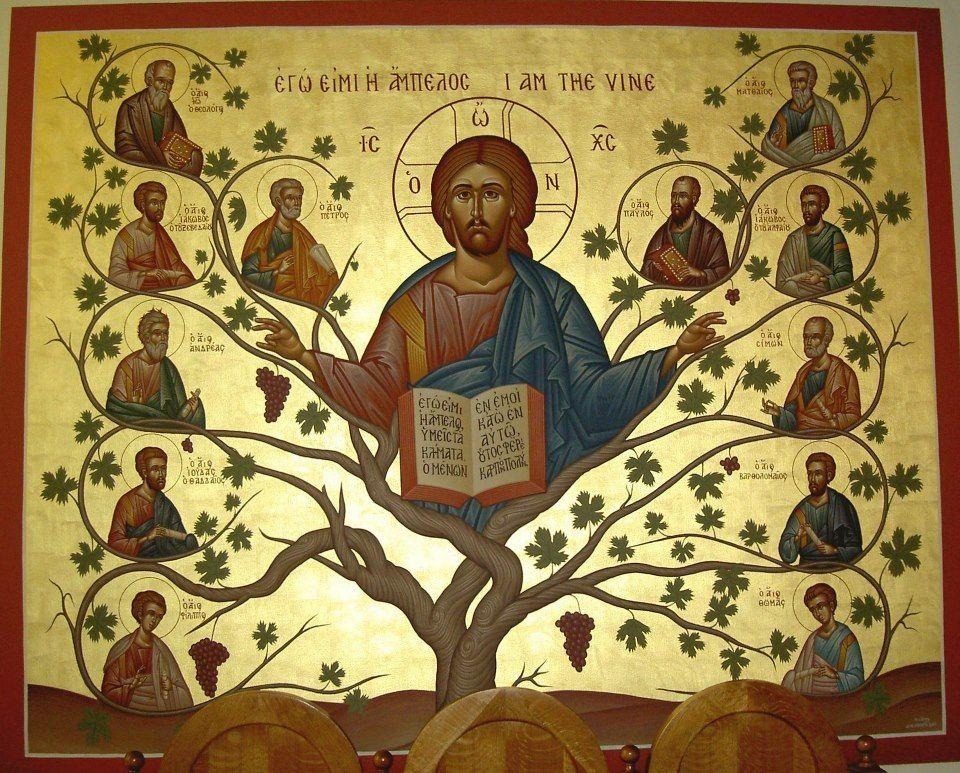
Image: Byzantine icon – Christ the Vine