Freely, freely
Is Christian discipleship really the ‘high-risk, high-reward’ venture we sometimes think it is?
The following homily was preached to the student brothers during Compline. You can listen here or read below:
Reading: Matthew 10:7-13
Consulting an economist can be a tricky affair, because they think with both hands. That’s because their conclusions may come in the form On the one hand … on the other hand … This approach makes sense in a world ridden with risk. One who embarks on a new venture would be prudent to get a cost-benefit analysis – he’d be unwise not to hedge his bets.
It can be tempting to treat our relationship with God in a similarly transactional way. To have faith is to be joined to God as to one unknown. We can’t see God the same way we see other people, and when it comes to our growth in holiness, it’s difficult to measure (unquantifiable) ‘results’. In this respect, following God lacks certainty.
But Christ comes along now – and complicates the picture. He seems to multiply the risk. On the one hand, he says, ‘You received without pay; give without pay.’ On the other hand, he says that ‘the labourer deserves his keep’, his food or sustenance. It seems the disciples are caught in a double bind – no remuneration, and no carrying necessities along with them. When it comes to following Christ, how risky is too risky?
The answer we often hear is that for the disciples, and for us as preachers, it’s a necessary risk to do without these things. We imitate the poverty of Christ by freeing ourselves from a concern with material affairs that would take time and sap energy away from preaching the Gospel, healing the sick, casting out devils. To do what Jesus says is to entrust oneself to the generosity of others.
For us Dominicans, vowed to voluntary poverty, this sustenance is sought through our begging for our bread (or, using the contemporary term, mission advancement). Our benefactors help to move our mission of continuing what the disciples do, and in doing so, become disciples themselves. And since we cannot repay our benefactors in a like-for-like way, we pray that God himself will be their reward.
And this shows the deeper reason the disciples are not rewarded in this life – the work they do is in the first place God’s. ‘In this is love, not that we loved God, but that he loved us first, and gave his Son to be the atoning-sacrifice for our sins’ (1 John 4:10). The disciples – you and I, every baptised Christian – we are commissioned to carry a message greater than ourselves. How can anyone pay for a product that is priceless?
We don’t have to. Christ has paid the price for us. ‘For you know the generous act of our Lord Jesus Christ, that though he was rich, for your sakes he became poor, so that by his poverty you might become rich’ (2 Cor 8:9). At a deeper level, to ask how risky is too risky when deciding whether to follow Jesus is to misplace the question. When it comes to our personal capacities, what we bring to the work of God, we don’t need to hedge our bets. We don’t need to think of our relationship with God as a high-risk, high-reward venture. St John Vianney says, ‘Man gives the little he can; God gives the rest.’ The disciples may not have carried a second tunic, but they remained who they were, with their gifts and talents, their joys and sorrows, the hard-won wisdom of the road of faith, and most of all, their experience of Jesus, the Gospel. God has given us everything we are and have, and he calls us – as we are – to serve him as we ourselves can.
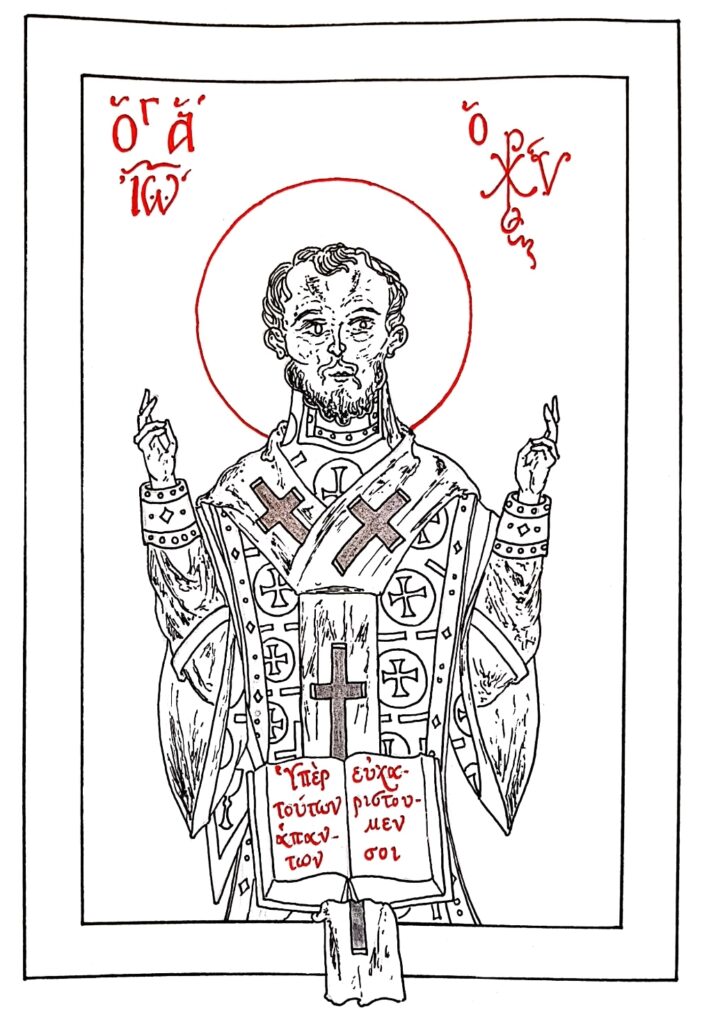
Today’s Gospel is more than just an employee manual. The economy Christ has come to fulfil is the economy of salvation. And this he shows us with both hands, outstretched, crucified. The price is paid. ‘Open-handed, he has given to the poor’ (Ps 112:9). God’s goodness to us is infinite, and he has given us all we need to serve him, ‘for from his fulness we have all received grace upon grace’ (John 1:16).
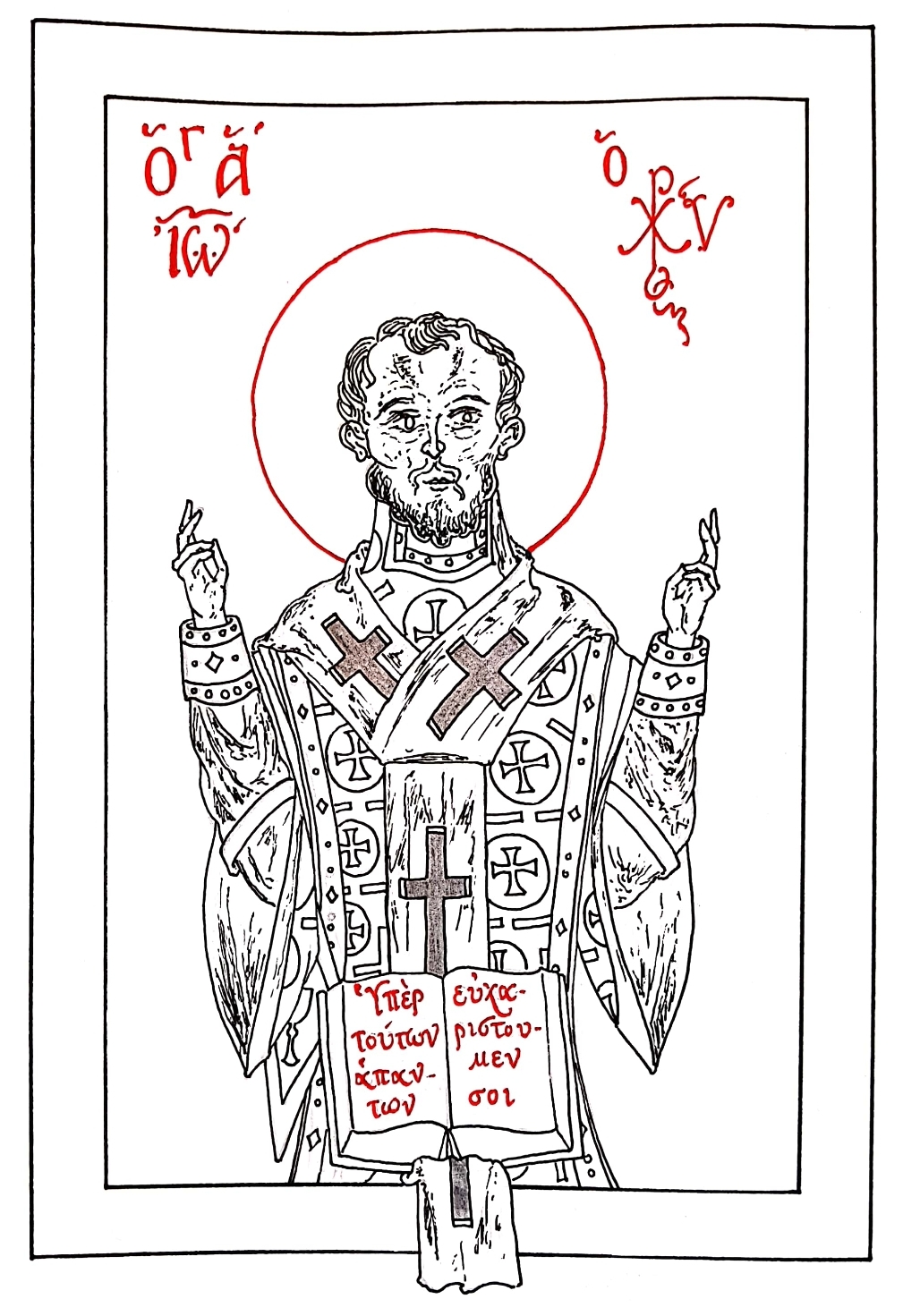
Image: St John Chrysostom celebrating the Divine Liturgy, with both hands (Augustine Chen OP, 2023)