

Does It Make Sense?
What does strength in weakness mean? And is scripture ever as straightforward as it seems?
The following homily was preached to the student brothers during Compline. You can listen here or read below:
Reading: Luke 11:14-23
‘I have never seen anyone die for the ontological argument,’ says the 20th century existentialist philosopher Albert Camus. But today, Jesus shows how reasonable it is to follow him, by a still more excellent way.
His naysayers say that Jesus is a trickster, an illusionist, a soothsayer: he casts out demons by Satan’s power. But Jesus, the power and wisdom, the Logos, of God, responds with a logical argument, a reductio ad absurdum, in the following form:
- If Jesus casts out demons by Satan’s power, then Satan’s kingdom is internally divided.
- Now a divided kingdom collapses.
- Yet Satan’s kingdom still operates – we know this because Jesus will be given over to the soldiers, mocked, scourged, killed.
- Therefore, the accusation that Jesus is an agent of Satan is false.
Suddenly everything has become more ominous. Jesus seems to suggest that at the moment when he was speaking, Satan was still at work. The plot thickens, especially when Jesus says a strong man could be overpowered by one stronger than he. We usually take this to mean Jesus overpowering Satan.
But the converse could also be true. Jesus is the strong man who guards his property, his flock, his disciples. He prays they might overcome temptation. But Jesus is attacked and overpowered when he is bound and scourged. His armour is taken away when he is stripped of his garments. His plunder is divided when they cast lots for his robe. Jesus has made himself weak. But we know he was the stronger one all along.
Three weeks ago tonight Br Jerome pointed out that only by taking up our cross do we follow Jesus in his weakness through his death to his resurrection. Since then, we’ve tried to keep up with our penances. We’ve felt searched and penetrated by the way our sins have wounded us. We’ve been reminded, all too dearly, of our vulnerabilities, proclivities, weaknesses. We’ve come face-to-face with our demons. If you’ve floundered and faltered, join the club of which I’ve long been a member.
The point of today’s Gospel, the point of all our penance, is this. God makes himself weak to show us not to pretend to be the strong man. And in all this God makes sense of all the absurdity in the world. He makes sense of our daily existence and experience of pain. He has shown himself stronger than death by rising from the grave. He says, ‘My power is made perfect in weakness.’ ‘I have come to call not the righteous, but sinners, to repentance.’ There we have it. God cannot heal the saint I pretend to be. But he can heal the sinner I am.
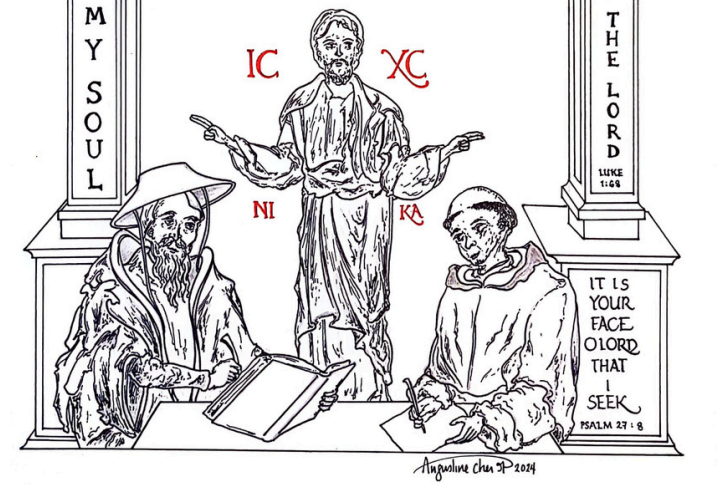
Image: Excerpt from the Invitation to the Solemn Profession of Jerome Johnson (Augustine Chen OP, 2024)


Joshua
Yes, Br. Augustine Chen, it does make sense that it’s in our weaknesses that God enters to save, renew and strengthen us.
Thanks for being a vessel of clarity.
Sincerely,
Michael O Driscoll
Thank you so much for a thought provoking homily which reminds me to be grateful for my Happy Fault(s) and that Jesus came to call sinners.